


RCMP Salaries by Rank in Canada (2026 Complete Guide)
Quick Answer: RCMP constables start at $71,191/year and reach $115,350 within 36 months. Corporals earn $121,691–$126,311. Sergeants earn $133,677. Commissioned officers earn $125,000–$237,000+. For the complete pay grid with after-tax estimates and pension math, see the RCMP salary guide.
RCMP Salary by Rank — Full Table (2026)

| Rank | Annual Salary |
|---|---|
| Cadet (in training) | $1,000/week — increased April 1, 2026 |
| Constable — Step 1 | $71,191 |
| Constable — Step 2 (6 months) | $92,497 |
| Constable — Step 3 (12 months) | $100,356 |
| Constable — Step 4 (24 months) | $108,220 |
| Constable — Step 5 (36 months) | $115,350 |
| Corporal — Step 1 | $121,691 |
| Corporal — Step 2 | $126,311 |
| Sergeant | $133,677 |
| Staff Sergeant | $146,019 |
| Sergeant Major | $150,524 |
| Inspector | $125,000–$140,000 |
| Superintendent | $140,000–$155,000 |
| Chief Superintendent | $155,000–$170,000 |
| Assistant Commissioner+ | $170,000+ |
| Deputy Commissioner | $214,988–$237,352 |
Constable Salary — Step-by-Step Breakdown
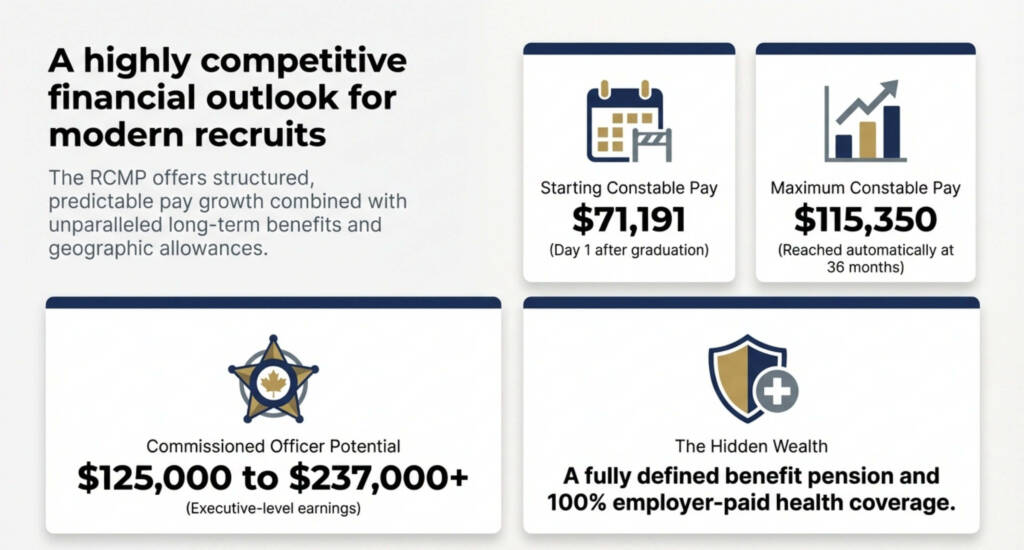
Day 1 after Depot: $71,191/year | 6 months: $92,497 | 12 months: $100,356 | 24 months: $108,220 | 36 months: $115,350 (maximum constable pay)
All increases are automatic — you do not apply for them.
Cadet Pay During Depot Training
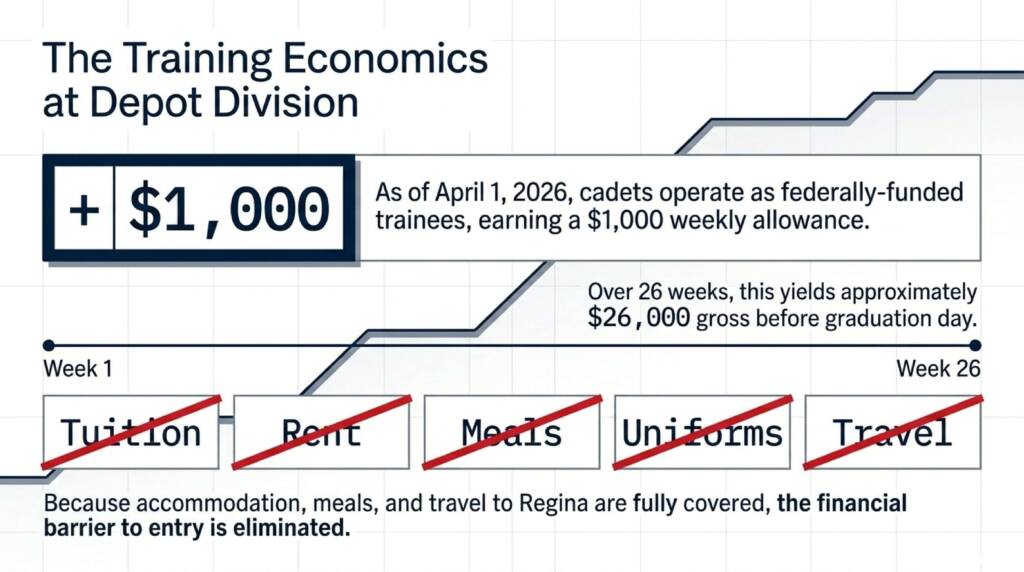
As of April 1, 2026, cadets earn $1,000 per week during the 26-week Depot program. Take-home is typically $850–$900/week after deductions. Accommodation, meals, uniforms, and travel are covered separately.
Corporal Salary
Corporal is the first supervisory rank. Step 1: $121,691/year. Step 2: $126,311/year. For a full breakdown, see the RCMP Corporal salary guide.
Sergeant Salary
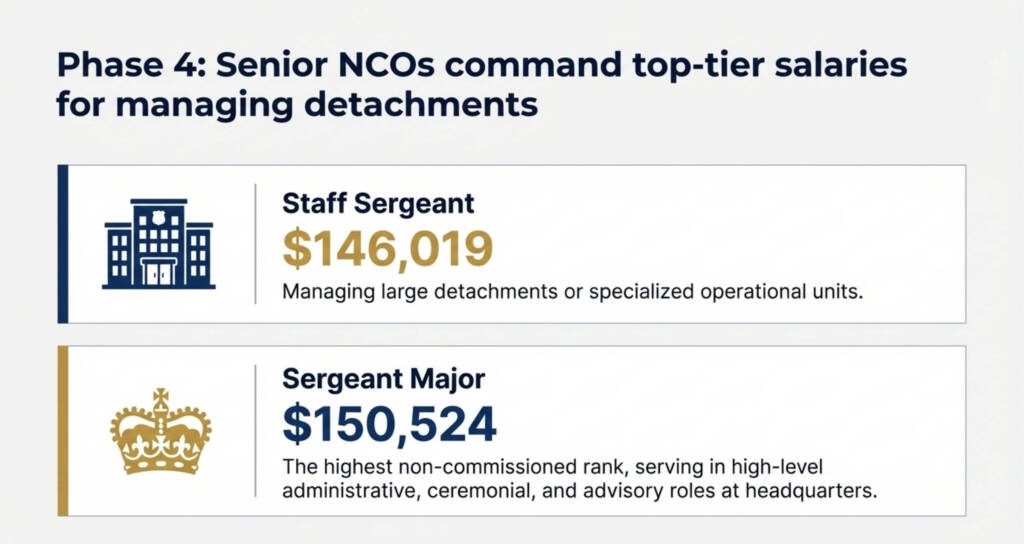
Sergeants earn $133,677/year (~$7,043/month, ~$64.27/hour). For more detail, see the RCMP Sergeant salary guide.
Staff Sergeant and Sergeant Major
Staff Sergeant: $146,019/year. Sergeant Major: $150,524/year — the highest non-commissioned rank, serving in administrative and advisory roles.
Commissioned Officer Salaries
| Commissioned Rank | Salary Range |
|---|---|
| Inspector | $125,000–$140,000 |
| Superintendent | $140,000–$155,000 |
| Chief Superintendent | $155,000–$170,000 |
| Assistant Commissioner+ | $170,000+ |
| Deputy Commissioner | $214,988–$237,352 |
For a full breakdown, see the RCMP commissioned officer salary guide.
Most salary comparisons stop at base pay. They miss the defined benefit pension, which adds a layer no annual figure captures. An officer who joins at 22, reaches sergeant by year 15, and retires after 25 years is eligible for an indexed pension from roughly age 47 — potentially over $2 million in lifetime payouts. That pension is not market-dependent. Municipal forces often offer lower pension indexing or none at all. No comparison between RCMP pay and municipal pay is accurate without this difference in retirement security factored in.
The 2025–2026 Pay Raise
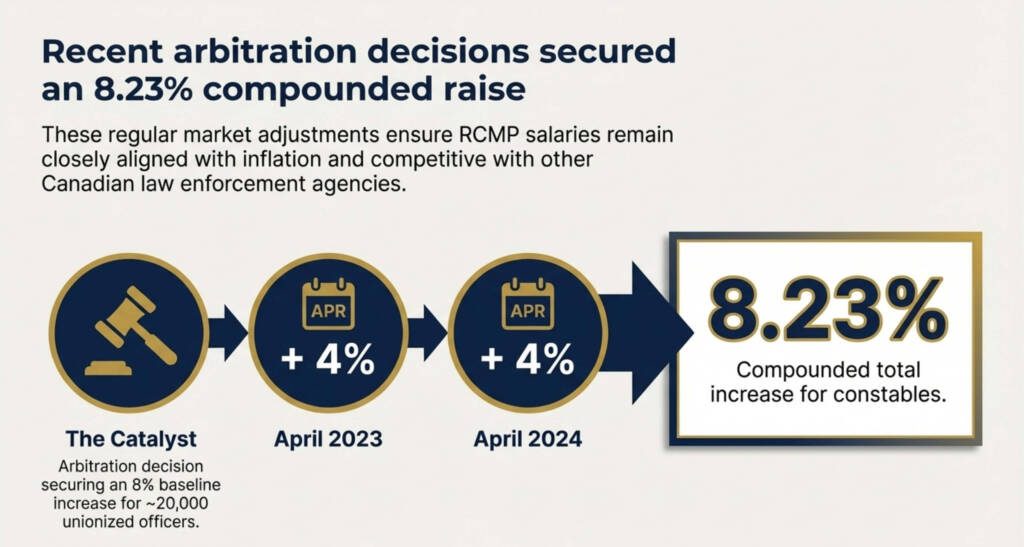
In 2023–2024, ~20,000 RCMP officers received an 8% salary increase through arbitration: 4% on April 1, 2023 and 4% on April 1, 2024 (compounded: ~8.23%).
Benefits Package
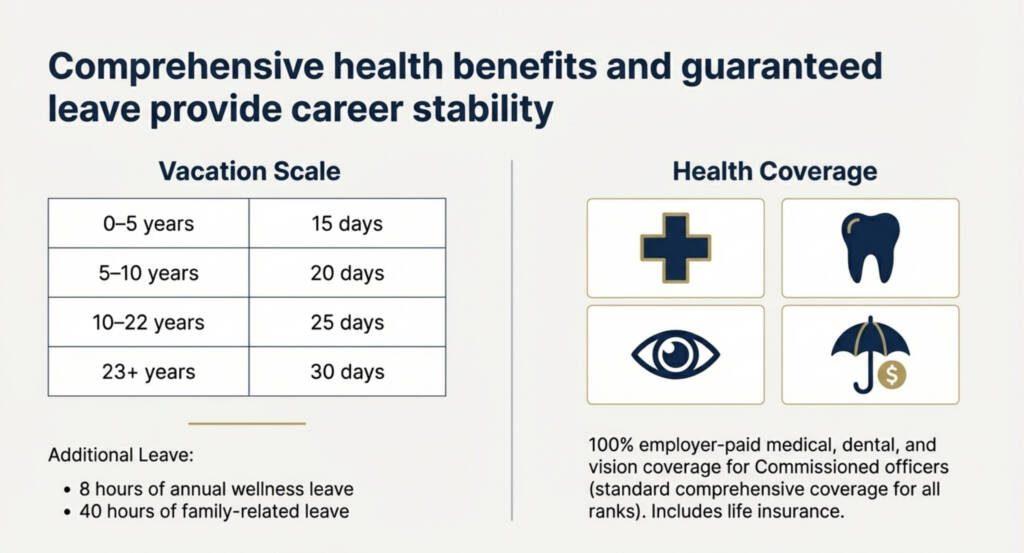
RCMP total compensation includes: full medical, dental, and vision coverage; a defined benefit pension (full pension after 25 years, maximum after 35); vacation scaling from 15 to 30 days by years of service; life insurance; and up to $1,500 annually for continuing education.
Allowances and Additional Pay
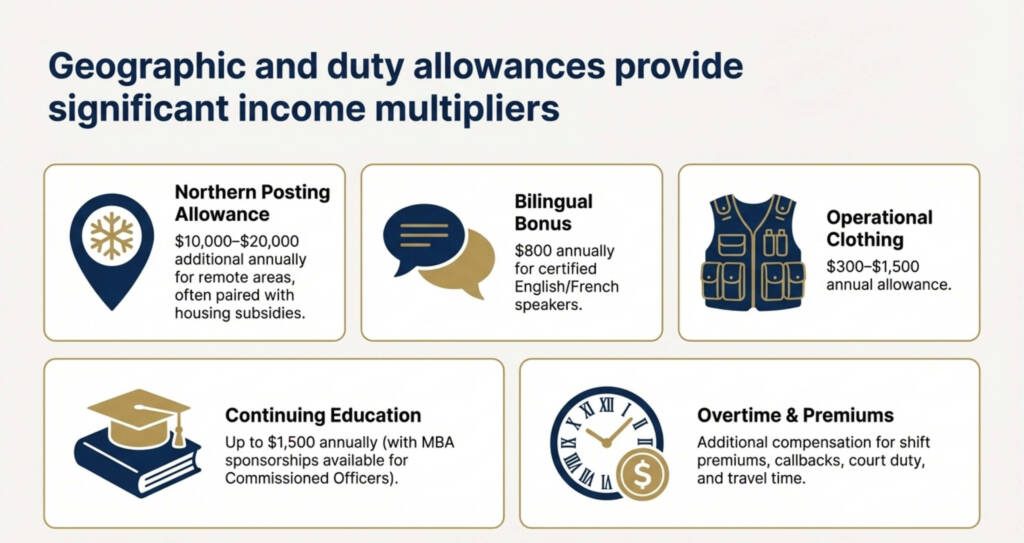
Additional pay includes: northern posting allowance ($10,000–$20,000/year), bilingual bonus ($800/year), operational clothing allowance ($300–$1,500), shift premiums, callback pay, court duty compensation, and travel time allowances. When comparing offers, understand how income tax applies to RCMP pay.
How Does RCMP Pay Compare to Other Canadian Police Forces?
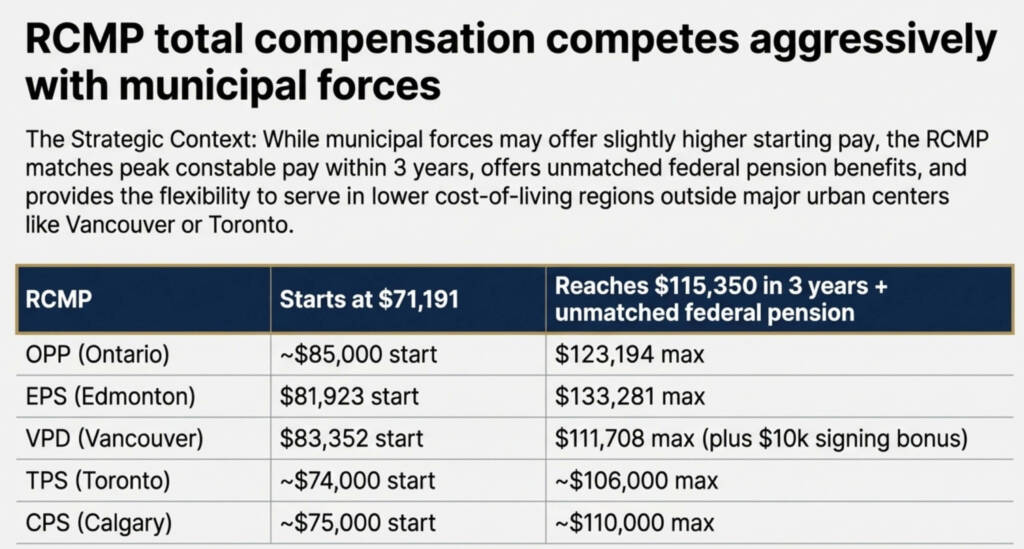
| Police Force | Starting Salary | Max Constable Salary | Notes |
|---|---|---|---|
| RCMP | $71,191 | $115,350 | 36 months; federal pension + benefits |
| OPP | ~$85,000 | $123,194 | Ontario 2026 contract |
| Toronto Police | ~$74,000 | ~$106,000 | Municipal |
| Vancouver Police | $83,352 | $111,708 | Plus $10,000 signing bonus |
| Edmonton Police | $81,923 | $133,281 | Highest ceiling in comparison |
| Calgary Police | ~$75,000 | ~$110,000 | Estimated |
Sources: RCMP Treasury Board collective agreement | OPP 2024 contract | VPD recruiting page | EPS joineps.ca | Calgary Police public data
A senior constable at a large municipal force can earn $10,000–$20,000 more annually than an RCMP constable at the same experience level. That gap narrows significantly when the defined benefit pension is included. The RCMP pension provides indexed payments from roughly age 47 for a 25-year member — a benefit no stock-market-dependent plan can guarantee. No salary comparison is complete without this difference factored in.
RCMP Rates of Pay
The official RCMP rates of pay are set through the collective agreement between the National Police Federation (NPF) and Treasury Board of Canada. Effective April 1, 2024, these rates apply to all Regular Members across Canada.
Constable rates of pay advance automatically at fixed service milestones — no application required. The largest jump comes at six months: from $71,191 to $92,497, an increase of over $21,000. The full official rates of pay schedule is published by Treasury Board at canada.ca.
RCMP Pay Grades
The RCMP uses a structured pay grade system grouping members by rank and time in service. Each grade has a defined salary band with automatic step increases.
| Pay Grade | Rank | Salary Range (2026) |
|---|---|---|
| Grade 1 (Steps 1–5) | Constable | $71,191 – $115,350 |
| Grade 2 (Steps 1–2) | Corporal | $121,691 – $126,311 |
| Grade 3 | Sergeant | $133,677 |
| Grade 4 | Staff Sergeant | $146,019 |
| Grade 5 | Sergeant Major | $150,524 |
| Officer Grades | Inspector to Deputy Commissioner | $125,000 – $237,352 |
Moving to a higher grade requires a competitive promotion process — the RCMP does not promote on seniority alone.
Is the RCMP Salary Worth It?
The RCMP offers structured, predictable pay growth. The full picture — base salary, pension, benefits, and allowances — makes RCMP compensation competitive with other federal and law enforcement careers in Canada. For the complete breakdown including after-tax take-home by province, see the full RCMP salary guide.
The 6-month constable pay jump is real but often misunderstood. Step 1 to Step 2 is an increase from $71,191 to $92,497 — more than $21,000 in a single step. But that step is conditional on completing the Field Coaching Program. Constables released during the FCP revert to their Step 1 rate. The progression is automatic only for members who remain in good standing through each service milestone.
How to Start Your RCMP Career
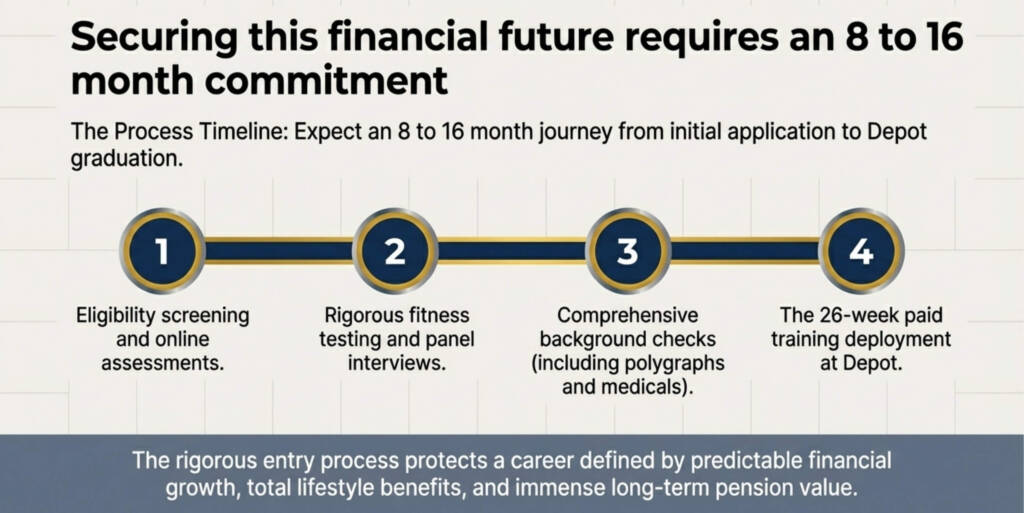
- How hard is it to get into the RCMP?
- RCMP application process — step by step
- Do RCMP recruits get paid during training?
The Step 1 constable rate of $71,191 is the starting point, not the representative salary. After six months, a constable earns $92,497 — above the median full-time wage in Canada. Most officers reach Step 5 ($115,350) within 36 months. That’s before northern allowances, bilingual bonuses, or overtime. Comparing Day 1 Depot wages to established career salaries is a framing error that understates RCMP compensation substantially.
Frequently Asked Questions
New RCMP constables earn $71,191/year on their first day after graduating from Depot. This increases to $92,497 after six months and reaches $115,350 after 36 months.
RCMP sergeants earn $133,677/year — approximately $7,043/month or $5,141 bi-weekly.
Yes. The RCMP pension is a defined benefit plan. Full pension after 25 years of service; maximum benefits after 35 years.
Base salaries are set nationally. Members in northern or remote postings receive geographic allowances of $10,000–$20,000 annually on top of base pay.
RCMP rates of pay are set by the NPF collective agreement with Treasury Board. As of April 1, 2026: constables start at $71,191 and reach $115,350 after 36 months; corporals earn $121,691–$126,311; sergeants earn $133,677. The full schedule is at canada.ca.
The RCMP pay grade system ties salary to rank and service. Constables: Grade 1 ($71,191–$115,350, 5 steps). Corporals: Grade 2 ($121,691–$126,311, 2 steps). Sergeant through Sergeant Major have single-rate grades. Commissioned officers have a separate band: $125,000–$237,352.
The RCMP constable pay scale: $71,191 on day 1, $92,497 at 6 months, $100,356 at 12 months, $108,220 at 24 months, $115,350 at 36 months. All increases are automatic.
Sources:
RCMP salary and benefits
Police officer pay and benefits; RCMP Salary Hub | Sergeant Salary | Corporal Salary | Commissioned Officer Salary | Cadet Pay | RCMP Collective Agreement 2023–2024
This article reflects current RCMP policy based on official government documentation. Eligibility and suitability decisions are assessed on a case-by-case basis during the application process.




4 Comments
Trish Jasinski
Hi. I currently work in an administrative capacity at a large sheriff’s office in the U.S. and contemplating moving to Canada. Where can I find info on support personnel positions? Thank you.
ryan
thank you very much for sharing RCMP Salary
nancy
thank you
ryan
i just applied thank you