

Yes — RCMP officers pay federal and provincial income tax on their salary, just like any other Canadian employee. They are not tax-exempt by virtue of being police officers. Income tax is withheld at source from every paycheque. However, two specific tax provisions apply uniquely to RCMP and other police officers: a deduction for international operational deployments, and a reserve-based exemption that applies to First Nations members.
Key Takeaways
- RCMP officers pay full federal and provincial income tax — there is no general police income tax exemption in Canada.
- One deduction exists specifically for police: Line 24400 on the T1 return, for officers deployed on international operational missions outside Canada.
- First Nations RCMP members may be exempt from income tax on income earned on a reserve, under paragraph 81(1)(a) of the Income Tax Act.
- All extra-duty pay (overtime, shift premiums, court time) is taxable and reported on a T4 slip.
Regular RCMP Salary Is Fully Taxable
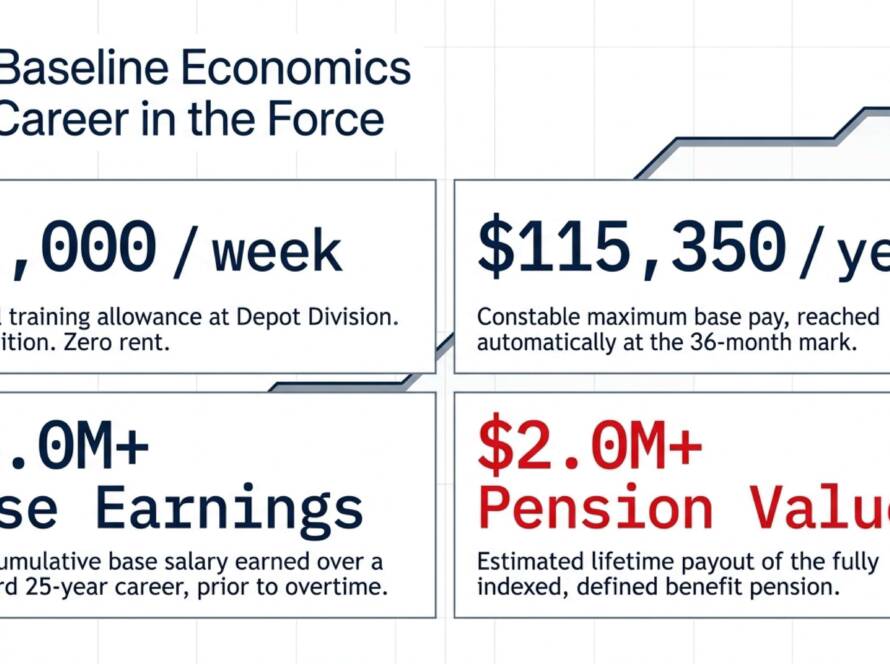
RCMP officers are federal government employees paid under the Treasury Board Collective Agreement. Like all Canadian employees, their employment income is subject to federal income tax, provincial or territorial income tax, Canada Pension Plan contributions, and Employment Insurance premiums. These deductions are withheld automatically from each bi-weekly paycheque. An RCMP constable earning $115,350 at Step 5 pays the same marginal tax rates as a teacher, accountant, or engineer at the same income level.
There is no blanket exemption from income tax for being a police officer in Canada. The idea that law enforcement personnel pay no tax is a myth with no basis in Canadian tax law.
The One Deduction That Does Apply: Line 24400
There is one specific tax provision for Canadian police officers: the Canadian Armed Forces Personnel and Police Deduction, claimed on Line 24400 of the T1 personal income tax return.
This deduction applies when a police officer is deployed outside Canada on an international operational mission — such as a UN peacekeeping mission, training mission, or international security operation. Canada has sent RCMP officers to missions in Lebanon, the West Bank, Afghanistan, Haiti, and other locations (Canada Revenue Agency, Line 24400 guidance, updated January 20, 2026).
Effective for 2017 and subsequent tax years, the deduction applies to all qualifying international deployments regardless of the risk level of the mission. The maximum deductible amount equals the highest level of pay earned by a Lieutenant-Colonel of the Canadian Armed Forces in the relevant tax year. The eligible amount appears in Box 43 of the officer’s T4 slip — it doesn’t require calculation; the employer reports it directly. Not all RCMP officers will ever qualify for this deduction. Most serve domestically throughout their careers.
First Nations Income Tax Exemption
The RCMP’s own pay and benefits page (updated April 1, 2026) notes that First Nations members may be exempt from income tax under paragraph 81(1)(a) of the Income Tax Act and section 87 of the Indian Act if the income is earned on a reserve. This exemption is not specific to police officers — it is a provision of Canadian tax law that applies to eligible First Nations individuals earning income on reserve. RCMP members who qualify should contact the Canada Revenue Agency directly for guidance on their specific situation.
Extra-Duty Pay Is Also Taxable
The RCMP offers extra-duty pay for overtime, shift premiums, callback, court duty, travel time, and transportation (rcmp.ca Pay and Benefits, updated April 1, 2026). All of these payments are employment income subject to income tax, CPP, and EI deductions. When a third party pays an officer for special duty services — for example, a sporting event or construction company that hires police for traffic control — the payment is reported on a separate T4 slip, and income tax is withheld either by the third party or by the RCMP under the CRA’s administrative policy (CRA, updated April 29, 2026).
Other Allowances and Their Tax Treatment
Several RCMP allowances exist alongside base salary. The bilingual bonus ($800/year) and operational clothing allowance ($300–$1,500/year) are employment income and taxable. The isolated post allowance — paid to officers at remote postings — includes components for environment, living cost differential, fuel and utilities, and shelter costs. These allowances are generally taxable employment income unless a specific CRA exclusion applies. Officers in isolated postings should review their T4 slips carefully and may benefit from tax advice specific to allowance treatment.
For the complete RCMP compensation picture, see the RCMP Salary guide and the RCMP Pension Plan article.
This article is for informational purposes only and does not constitute tax advice. Consult the CRA at canada.ca or a tax professional for advice specific to your situation.
RCMP officers are federal government employees paid under the Treasury Board Collective Agreement.
There is one specific tax provision for Canadian police officers: the Canadian Armed Forces Personnel and Police Deduction, claimed on
The RCMP’s own pay and benefits page (updated April 1, 2026) notes that First Nations members may be exempt from
The RCMP offers extra-duty pay for overtime, shift premiums, callback, court duty, travel time, and transportation (rcmp.ca Pay and Benefits,
Sources: RCMP, “Pay and benefits,” rcmp.ca, updated April 1, 2026; Canada Revenue Agency, “Line 24400 – Canadian Armed Forces personnel and police deduction,” canada.ca, updated January 20, 2026; CRA, “Payments to police officers for special or extra duty services,” canada.ca, updated April 29, 2026; Knowledge Bureau, “Military and Police Members Eligible for Tax Relief,” knowledgebureau.com, April 23, 2025.