

Do RCMP Have to Be Clean Shaven?
Quick Answer: No, RCMP officers do not have to be clean shaven. Since May 2019, members can grow beards and facial hair between 0.5 cm and 2.5 cm in length, provided they keep it neatly groomed and symmetrical. However, officers must be prepared to shave immediately if safety equipment like gas masks requires a proper facial seal.
For roles, postings, and specializations, see our RCMP careers guide.
By Emily Clarke, Communications Specialist
The Royal Canadian Mounted Police has undergone a dramatic transformation in its grooming standards. For over a century, the clean-shaven face was a non-negotiable part of the RCMP uniform—a symbol of discipline rooted in paramilitary tradition. Today, that rigid standard has given way to a more inclusive policy that balances professional appearance with modern expectations and individual expression.
First postings and specializations follow operational need — not personal preference. Most members start in general duty; specialized units usually come after field experience and competition.
The Historic Clean-Shaven Mandate
For generations, RCMP officers were required to maintain a clean-shaven appearance daily. The 1975 Uniform and Dress Manual established this strict prohibition, allowing only neatly trimmed moustaches that couldn’t extend below the corners of the mouth. This standard wasn’t simply about aesthetics—it represented the organizational identity of the Force.
Officers who violated the clean-shaven rule faced disciplinary action. As recently as 2017, an officer in Moncton, New Brunswick was removed from regular duties for growing a goatee. During the same year, some members grew beards as a form of protest during labor disputes, highlighting how deeply embedded the grooming requirement was in the Force’s culture.
The only exceptions came through medical or religious accommodations. Officers suffering from pseudofolliculitis barbae—a painful skin condition caused by shaving—could obtain medical profiles allowing short facial hair. The landmark case came in 1990 when Baltej Singh Dhillon, a devout Sikh, challenged the policy on religious grounds. The federal government ultimately authorized turbans and beards for religious reasons, establishing a legal precedent that would pave the way for broader change decades later.
The 2019 Policy Revolution
On May 22, 2019, the RCMP announced sweeping changes to its grooming standards. For the first time in nearly 45 years, all members—regardless of religious affiliation or medical need—were permitted to grow facial hair. This modernization reflected several converging pressures facing the organization.
The recruitment crisis played a significant role. Law enforcement agencies across North America struggle to attract younger applicants, and research showed that strict grooming policies created unnecessary barriers. Staff Sergeant Kevin Baillie explained that some potential recruits were “somewhat attached to their facial hair,” and relaxing the standard could “open us up to people who wouldn’t normally apply.”
Beyond recruitment, the policy change addressed internal morale. When members feel their needs are heard, it translates to better job performance and satisfaction. Sergeant Leanne Butler noted that listening to employee feedback “helps with morale,” making this a low-cost but high-impact improvement for the organization.
Current Facial Hair Standards
The liberalization of grooming standards doesn’t mean anything goes. The RCMP replaced “clean-shaven” with “neatly groomed,” backed by specific requirements designed to maintain professional appearance.
Officers can wear facial hair that measures between 0.5 cm and 2.5 cm in length and bulk—roughly one-quarter inch to one inch. The minimum prevents unkempt stubble, while the maximum ensures beards remain relatively close to the face and don’t interfere with equipment.
“Neatly groomed” means facial hair must be symmetrical and well-maintained. This typically includes shaving the neck below the jawline, maintaining clean cheek lines, and keeping the beard even in length. The standards mirror those adopted by the Canadian Armed Forces, which also implemented a 2.5 cm maximum for facial hair.
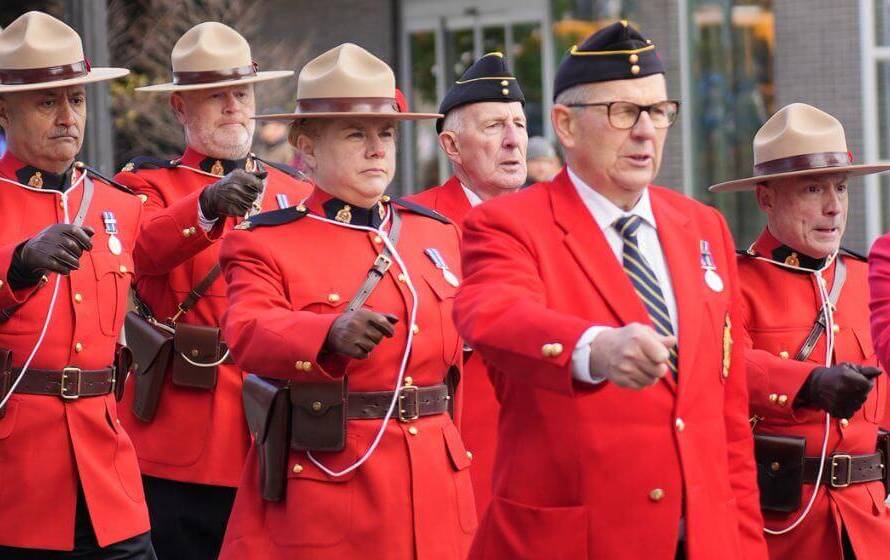
These requirements apply to all uniforms, including the iconic Red Serge ceremonial dress. Officers in full ceremonial regalia can now wear beards and religious headdresses like turbans, integrating these elements into the traditional uniform rather than treating them as exceptions.
The COVID-19 Safety Challenge
Less than a year after implementing the new policy, the RCMP faced an unexpected conflict between inclusivity and safety. The COVID-19 pandemic required frontline officers to wear properly fitted N95 respirators when dealing with the public, creating a technical problem: facial hair prevents the tight seal necessary for these masks to function effectively.
Federal workplace safety regulations under the Canada Labour Code explicitly require respirator users to be clean-shaven. Commissioner Brenda Lucki initially ordered all frontline members to shave, effectively suspending the 2019 beard policy. While this inconvenienced officers with fashion beards, it created a human rights crisis for Sikh and Muslim officers, who were involuntarily removed from operational duties and reassigned to desk roles.
The backlash was immediate and intense. The World Sikh Organization and National Police Federation protested, while Prime Minister Justin Trudeau publicly expressed disappointment, calling the policy a manifestation of systemic discrimination. By October 2020, the RCMP reversed the blanket shave order, implementing instead a risk-management approach.
Under the revised protocol, bearded officers are dispatched to calls where aerosol transmission risk is deemed low. For high-risk scenarios—such as enclosed spaces with symptomatic individuals—bearded officers either stand down or rely on clean-shaven colleagues. Officers retain the discretion to remain on administrative duties if they feel unsafe returning to frontline work without proper respiratory protection.
When Shaving Is Still Required
Despite the general allowance for facial hair, specific situations still require a clean-shaven face. Officers assigned to specialized units that regularly deploy gas masks—such as Emergency Response Teams using tear gas—typically maintain a clean-shaven status to ensure equipment functions properly.
General duty officers with beards often carry shaving kits in their gear. During critical incidents requiring full respiratory protection, like a chemical spill or hazardous materials response, they must be prepared to shave immediately in the field to safely use their protective equipment.
Annual fit testing for respirators remains mandatory. If an officer cannot achieve a proper seal during testing due to their beard, they may face restrictions on certain duties until the issue is resolved or alternative equipment becomes available.
The Future: Inclusive Respirator Technology
Recognizing that administrative workarounds are insufficient for a national police force that may face chemical, biological, or radiological threats, the RCMP launched the “Inclusive Respirator” challenge in partnership with Innovative Solutions Canada. The objective is to develop respirators providing N95 or P100 protection levels for personnel with facial hair.
The initiative offers substantial funding—up to $150,000 for proof of feasibility and up to $1 million for prototype development. The specifications are demanding: masks must accommodate facial hair ranging from stubble to full religious beards, integrate with tactical gear like radios and vision protection, and remain lightweight and portable for duty belt carry.
As of October 2024, companies like OpenAeros and Consequent Labs have advanced through the fit-evaluation phase, developing new mask geometries and testing methods. Once these inclusive respirators are fully deployed, the last remaining safety justification for mandatory shaving will likely disappear.
Comparing Standards Across Organizations
The RCMP’s grooming evolution mirrors changes in other Canadian security organizations. The Canadian Armed Forces adopted a similar 2.5 cm maximum for facial hair through their “Beardforgen” initiative. Interestingly, the CAF briefly removed almost all restrictions in September 2022, only to reinstate the 2.5 cm limit in July 2024 due to concerns about professional image.
The RCMP’s approach has been more measured. By establishing the 2.5 cm limit in 2019 and maintaining it consistently, the Force avoided the “scraggly mess” phase that plagued the military’s experiment with total deregulation. This stability suggests the RCMP’s policy was well-calibrated from the start to balance modern preferences with organizational discipline.
Common Misconceptions About RCMP Facial Hair
Many people still assume RCMP officers must be clean-shaven, likely because the requirement was in place for so long and remains deeply associated with the Force’s traditional image. Another misconception is that only religious officers can wear beards—this was true before 2019, but the current policy applies universally to all members.
Some also believe facial hair is prohibited in the Red Serge ceremonial uniform. This isn’t accurate. The grooming standards apply equally to all orders of dress, and bearded officers regularly appear in full ceremonial regalia at public events and parades.
There’s also confusion about length limits. The policy specifies both a minimum (0.5 cm) and maximum (2.5 cm), meaning officers cannot simply skip shaving for a few days. The requirement to maintain facial hair within these parameters ensures a professional appearance rather than an unkempt one.
Real-World Impact on Recruitment and Diversity
The policy change has had tangible effects on recruitment efforts. By removing an arbitrary barrier, the RCMP expanded its potential applicant pool to include individuals who previously would have been unwilling to adhere to the clean-shaven standard. For younger generations, facial hair is a common aspect of professional appearance, and the old prohibition felt outdated.
Beyond recruitment numbers, the policy promotes genuine inclusivity. When beards became a standard grooming option rather than a religious exemption, Sikh and Muslim officers integrated more seamlessly into the Force’s visual identity. This normalization reduces the “othering” effect that occurred when only certain officers could wear facial hair for religious reasons.
Staff members have reported improved morale since the policy change. The ability to maintain facial hair represents a quality-of-life improvement and signals that organizational leadership listens to employee concerns—an important factor in retention and job satisfaction.
Practical Considerations for RCMP Members
Officers considering growing a beard under the current policy should understand the practical requirements. The facial hair must reach at least 0.5 cm before it meets standards, meaning there’s a transition period where stubble won’t comply with regulations. Planning this transition during time off can help avoid complications.
Maintenance is crucial. “Neatly groomed” requires regular trimming to maintain the 2.5 cm maximum, plus attention to neck and cheek lines. Officers should invest in quality trimming tools and establish a consistent grooming routine.
The emergency shaving requirement means carrying a razor and shaving supplies as part of duty gear. While this situation arises rarely, being prepared ensures compliance with safety protocols during critical incidents. Some detachments provide additional guidance on how long Depot training prepares recruits for these practical aspects of service.
Frequently Asked Questions
Yes, all members can grow beards between 0.5-2.5 cm length.
No, grooming standards apply equally to all applicants meeting RCMP recruiting age requirements.
Not significantly, though candidates should understand that Depot training is demanding regardless of grooming choices.
The policy addresses facial hair without gender restrictions, accommodating all members.
Moustaches remain permitted and must be neatly trimmed within the general grooming standards.
Sources:
RCMP police officer career paths
RCMP careers
This article reflects current RCMP policy based on official government documentation. Eligibility and suitability decisions are assessed on a case-by-case basis during the application process.