

Is RCMP Depot Hard? The Complete Truth About Canada’s Police Training
Quick Answer: RCMP Depot is genuinely demanding. The 26-week residential program packs 820 instructional hours of federal law, physical conditioning, firearms, tactical driving, and scenario training into a continuous evaluation environment. Physical fitness is one barrier, but most cadets who don’t complete Depot struggle with the academic load or conduct standards, not fitness.
For full context on all aspects of life at the academy, start with the RCMP Depot training hub.
Most applicants prepare only for the fitness test and arrive underprepared for academics. The attrition drivers at Depot are exams (two-strike rule), firearms safety procedures, scenario performance, and conduct violations — not the physical conditioning sessions.
How long is RCMP Depot training?
Depot runs 26 weeks at the RCMP Academy in Regina, Saskatchewan. Unlike university semesters or part-time courses, Depot is fully residential and full-time. Cadets live on campus in a structured environment from Week 1. There are no breaks to go home between modules. The schedule runs morning to evening, six days a week in the early weeks, with a controlled pace building toward graduation.
For a detailed breakdown of what happens each week, see how long Depot training is.
Physical demands at RCMP Depot
Physical training is integrated throughout the 26 weeks, not concentrated in a single week. Cadets face multiple fitness checkpoints, including an 8-kilometre timed run and combat rings (a high-intensity defensive tactics circuit). Depot’s Physical Training instructors run conditioning sessions at various points during the program, and troops compete and encourage each other throughout.
Defensive tactics, ground defence, and restraint techniques add sustained physical load beyond what most fitness training programs replicate. Cadets are also required to perform in full duty equipment during some scenarios. Arriving PFA-ready is the baseline — not the ceiling. Those who arrive at minimum fitness standards often struggle mid-program when tactical intensity increases.
For station-level detail, see RCMP Depot physical training expectations and the RCMP fitness standards guide.
Academic and legal demands
Federal law is not optional reading at Depot — it is examined. The curriculum covers the Criminal Code of Canada, Charter rights, evidence law, use-of-force principles, and provincial statutes. Cadets are tested under a two-strike rule: fail the same exam twice and the consequence can be remediation or release from the program.
The academic load is compressed. Cadets must absorb significant legal knowledge while simultaneously attending physical training, defensive tactics blocks, and scenario exercises. Many cadets who arrive fit and motivated find the academic volume the most stressful element of training, not the physical conditioning.
Mental and emotional demands
Separation from family, early starts, structured living conditions, and constant evaluation create psychological pressure that persists throughout the 26 weeks. There is no quiet period mid-program where standards temporarily relax. Cadets report that the cumulative intensity — not any single test event — is what makes Depot genuinely difficult.
Drill (formally known as Dismounted Cavalry Drill) is a consistent pressure point. Cadets learn foot drill, respond to commands, and must execute precise coordinated movements as a troop. This builds composure and attention to detail under sustained stress — skills deliberately tested because they transfer directly to high-pressure field situations.
Troops share accommodations, undergo room inspections, and are evaluated as a unit — not only individually. Poor performance by one cadet can affect the whole troop. This shared accountability builds resilience and close working relationships, but it also means personal struggles have consequences that extend beyond the individual.
Applicants often ask if Depot is “physically hard” or “academically hard.” In practice, difficulty comes from both happening simultaneously with limited recovery time between blocks. The cadet who trains only in the gym and ignores law study often faces the same outcome as the one who studies but arrives unfit.
What makes Depot hard in practice
The difficulty is cumulative across six domains running in parallel:
| Domain | What it involves | Where people fail |
|---|---|---|
| Academics | Criminal Code, Charter, use-of-force, evidence law | Two-strike exam rule; compressed study time |
| Physical fitness | 8km timed run, combat rings, PFA stations, DT circuits | Arriving at minimum, not performing at sustained intensity |
| Firearms | Marksmanship, safety protocols, timed qualification | Safety violations (zero tolerance); insufficient range practice |
| Scenario training | Simulated calls, use-of-force decisions, suspect management | Poor judgment calls; inconsistent application of law |
| Police driving | Emergency response driving, vehicle handling | Failing practical evaluations |
| Conduct and drill | Room inspections, uniform standards, Dismounted Cavalry Drill | Cumulative violations; troop accountability pressure |
All six run concurrently. You cannot bank credits from a strong week in one domain to offset a weak week in another. For detailed outcomes if standards are not met, see can you fail RCMP Depot. For preparation strategy, see how to prepare for RCMP Depot and what a day at Depot looks like.
Physical fitness is necessary but not sufficient. Cadets are released from Depot for academic failures, safety violations, conduct issues, and integrity concerns — not only fitness shortfalls. Instructors and former graduates consistently report that attitude, consistency, and honesty under pressure matter more than baseline fitness scores.
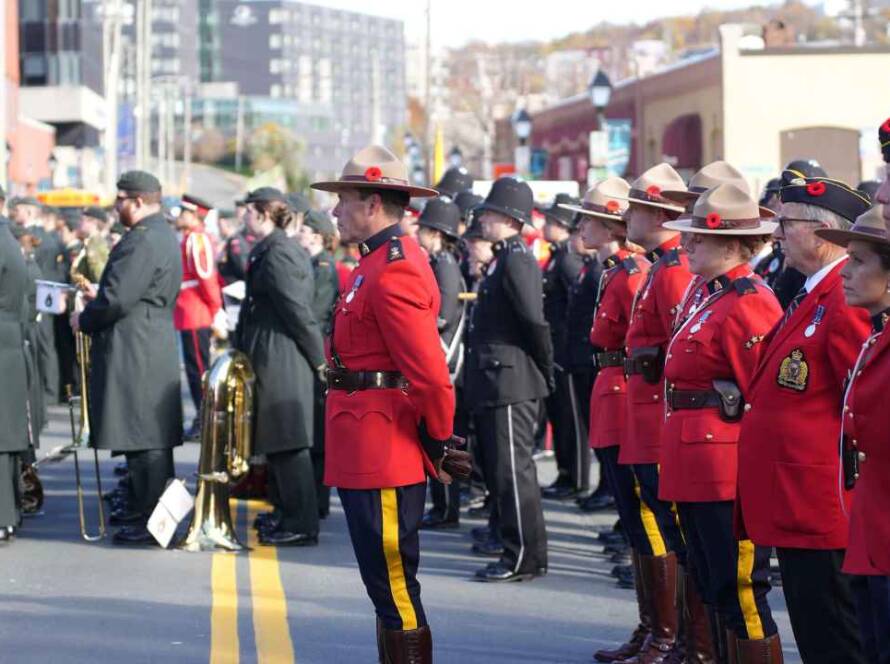
Depot milestones matter. Receiving your Stetson, earning your marching orders, and being issued the Review Order uniform (Red Serge) are real markers of progress — not just ceremony. Cadets who focus on the next milestone rather than the remaining weeks tend to sustain motivation more effectively through the mid-program slump around weeks 10–14.
Frequently Asked Questions
Yes. Depot is intentionally demanding across all six domains — fitness, academics, firearms, scenarios, driving, and conduct — simultaneously, not sequentially.
Yes. Fitness checkpoints run throughout the 26 weeks. Cadets who arrive near the minimum and don’t progress can fail fitness evaluations mid-program.
RCMP Depot training is 26 weeks of full-time residential instruction at the Academy in Regina, Saskatchewan. There are no scheduled breaks to return home between modules.
For most cadets, it’s the academic volume. Federal law, Criminal Code exams, and the two-strike rule catch many otherwise-prepared cadets off guard when combined with physical and tactical demands.
Arrive PFA-ready, build study routines for legal material before you go, and mentally prepare for sustained schedule intensity rather than any single peak challenge.
Sources:
Cadet Training Program | Royal Canadian Mounted Police
Depot Division | Royal Canadian Mounted Police
Nine things you might experience as a recruit at Depot | National Police Federation
This article reflects current RCMP training structure based on official government documentation and publicly available accounts from cadets and graduates.