

What are the divisions of the RCMP?
For roles, postings, and specializations, see our RCMP careers guide.
What Are the Divisions of the RCMP?
Quick Answer:By Sophie Tremblay, Communications Specialist
The RCMP operates through 15 divisions across Canada, each identified by a letter (B through V, excluding I, Q, R, S, T, U, W, X, Y, Z) and responsible for a specific province or territory. Additionally, there’s National Division in Ottawa and Depot Division in Regina for training. Each division serves federal, provincial, or municipal policing needs depending on local arrangements.
The Royal Canadian Mounted Police stands as Canada’s national police service, but understanding how this massive organization operates requires looking at its unique divisional structure. This system, rooted in 19th-century cavalry traditions, continues to shape how policing is delivered across the second-largest country in the world.

First postings and specializations follow operational need — not personal preference. Most members start in general duty; specialized units usually come after field experience and competition.
The Historical Roots of RCMP Divisions
The divisional letter system didn’t start as an administrative choice—it began with horses. When the North-West Mounted Police prepared for their famous March West in 1874, they organized 300 members into six troops labeled A through F. Each troop rode horses of a specific color: dark bay, dark brown, light chestnut, grey, black, and light bay. This visual coding system helped manage logistics during the trek across the prairies.
As these mobile cavalry units reached their destinations and established permanent forts, the letter designations transferred from the troops to the geographic regions they patrolled. F Troop’s settlement in Saskatchewan territory, for instance, permanently linked the letter F with that province. This tradition continues today, connecting modern policing operations to frontier heritage.
The Complete List of RCMP Divisions
National and Training Divisions
National Division operates from Ottawa, Ontario, serving the nation’s capital region. This division handles protective services for government officials, sensitive federal investigations, and coordinates international law enforcement cooperation. Unlike other divisions tied to provinces, National Division serves federal interests nationwide.
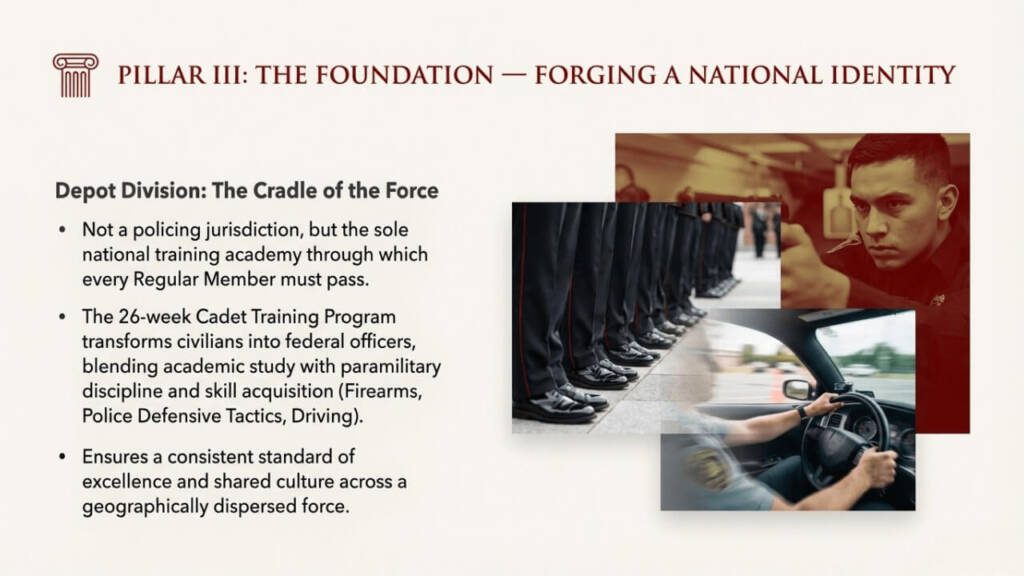
Depot Division in Regina, Saskatchewan functions as the RCMP Academy. Every Regular Member of the force completes the rigorous 26-week training program at Depot, regardless of where they’ll eventually serve. This centralized training makes sure standards stay consistent across all divisions
Provincial and Territorial Divisions
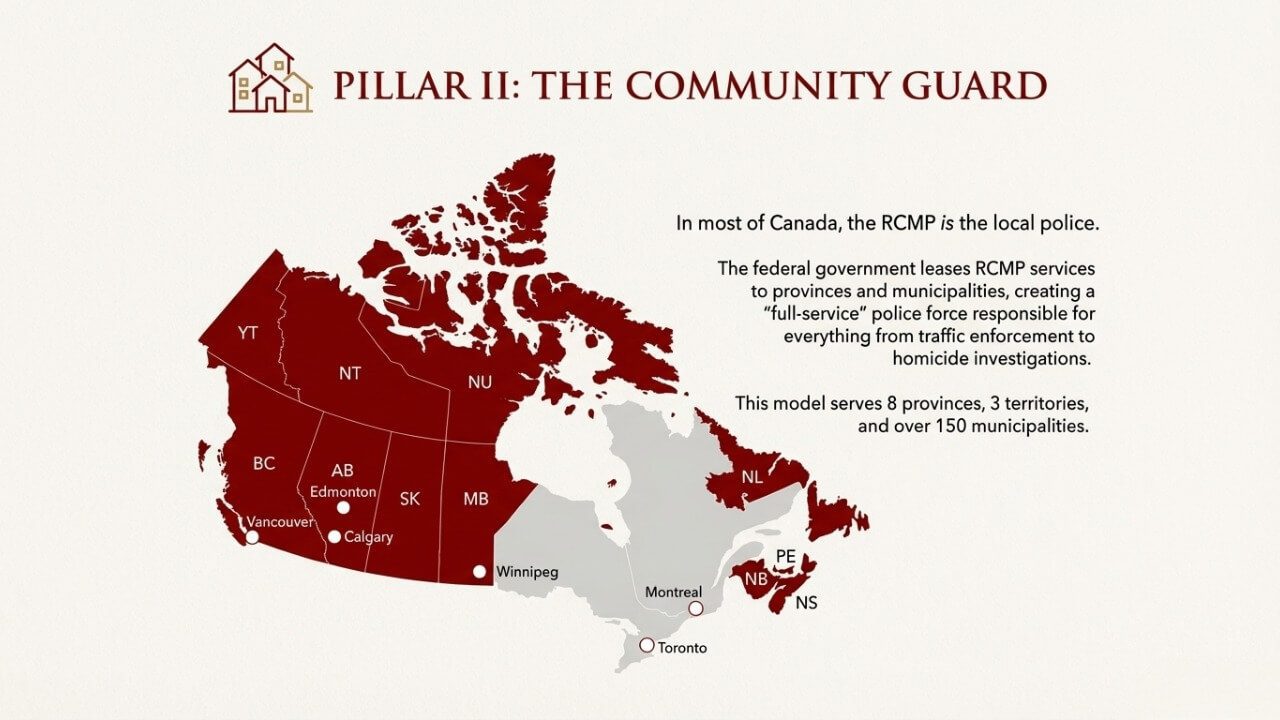
The remaining 15 divisions each serve specific provinces or territories:
- B Division – Newfoundland and Labrador (St. John’s)
- C Division – Quebec (Montreal)
- D Division – Manitoba (Winnipeg)
- E Division – British Columbia (Surrey)
- F Division – Saskatchewan (Regina)
- G Division – Northwest Territories (Yellowknife)
- H Division – Nova Scotia (Halifax)
- J Division – New Brunswick (Fredericton)
- K Division – Alberta (Edmonton)
- L Division – Prince Edward Island (Charlottetown)
- M Division – Yukon (Whitehorse)
- O Division – Ontario (London)
- V Division – Nunavut (Iqaluit)
Certain letters like I, Q, and S were never assigned to avoid confusion with numbers or other organizations. This lettering system provides clear identification while honoring the force’s cavalry origins.
Size and Scale Differences Between Divisions
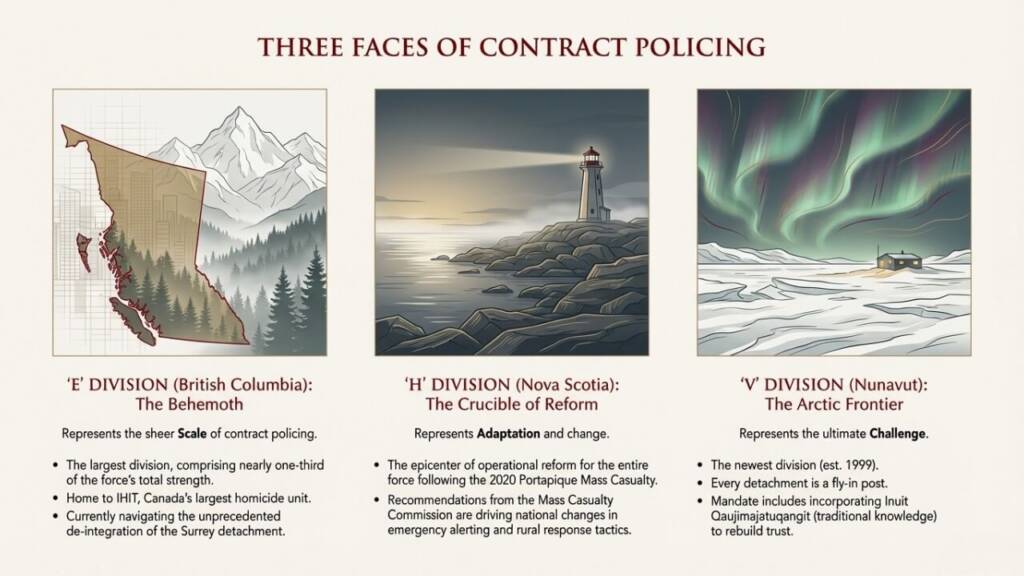
Not all divisions operate at the same scale. E Division in British Columbia stands as the largest, employing approximately 7,100 sworn members and 1,700 civilian staff—roughly one-third of the entire RCMP workforce. This massive division operates 144 detachments covering 99 percent of BC’s geography and serves 72 percent of the province’s population.
K Division in Alberta ranks as the second-largest, while smaller divisions like L Division in Prince Edward Island operate just a handful of detachments. These size differences reflect both geographic realities and population distribution. A member serving in a busy Lower Mainland detachment in E Division experiences vastly different daily realities than a colleague posted to a remote fly-in community in V Division.
The northern territorial divisions—G, M, and V—face unique challenges. Many communities they serve lack road access, requiring members to fly between detachments. Operating costs in these regions far exceed southern divisions due to logistics, housing, and transportation expenses.
How Divisions Organize Their Mandates
Each division balances three primary responsibilities, though the mix varies significantly by location.
Federal Policing Operations
Federal policing addresses serious threats like national security, organized crime, cybercrime, and border integrity. Every division maintains federal policing capacity, but C Division in Quebec, O Division in Ontario, and National Division focus almost exclusively on federal mandates. These provinces maintain their own provincial police forces (Sûreté du Québec and Ontario Provincial Police), so the RCMP concentrates on federal investigations.
National Division houses specialized units investigating government corruption, electoral fraud, and threats to democratic institutions. These sensitive cases require independence from local political pressures. O Division manages sophisticated financial crime investigations through Integrated Market Enforcement Teams, targeting capital markets fraud and money laundering schemes affecting Canada’s economic stability.
Contract Policing Services
Contract policing represents the RCMP’s largest operational mandate. Eight provinces and three territories contract the RCMP to provide provincial or municipal policing services. Under these agreements, divisions deliver full-service policing—from traffic enforcement to homicide investigations—for communities that don’t maintain their own police forces.
The cost-sharing arrangement typically sees provincial governments pay 70 percent while the federal government contributes 30 percent for smaller municipalities. Larger cities with populations above 15,000 pay 90 percent, with Ottawa covering the remaining 10 percent. This model makes professional policing accessible to communities that couldn’t afford standalone services.
Divisions like E, K, D, and F operate as provincial police forces under the RCMP banner. Members respond to 911 calls, investigate local crimes, and maintain community relationships while retaining federal policing capabilities. This dual mandate distinguishes the RCMP from purely federal agencies like the FBI.
Specialized Support Services
Divisions access centralized specialized services including forensic laboratories, the Canadian Firearms Program, and advanced training through the Canadian Police College. These services make sure even remote detachments can access world-class investigative support. A sexual assault investigation in a small northern community receives the same DNA analysis capabilities as a major urban case.
Regional Districts and Integrated Teams
Large divisions subdivide into districts for efficient service delivery. E Division operates four districts: Island, Lower Mainland, North, and Southeast. Each district coordinates resources across multiple detachments, ensuring specialized capabilities reach where they’re needed.
Integrated policing teams bring together officers from federal, provincial, and municipal jurisdictions to address specific criminal challenges. The Integrated Homicide Investigation Team in E Division, for instance, handles murder cases across the Lower Mainland for both RCMP detachments and several municipal police partners. This regional approach provides investigative depth that individual agencies couldn’t sustain alone.
Other integrated units focus on border enforcement, auto theft, and cybercrime. These teams overcome jurisdictional boundaries that criminals often exploit, enabling coordinated responses to cross-border or multi-regional crimes.
Specialized Divisional Capabilities
Certain divisions develop specialized capabilities matching their geographic and operational needs.
K Division operates Canada’s only Real Time Operations Centre, functioning 24/7 to track suspects and coordinate emergency responses. This modern facility consolidated 911 calls, surveillance feeds, incident reports, and social media monitoring into a central hub. In 2024 alone, the RTOC assisted with over 15,000 calls, demonstrating how technology enhances traditional policing.
Depot Division serves the national training mission, delivering the Cadet Training Program in both English and French. Beyond basic cadet training, the Academy provides advanced courses to Canadian and international law enforcement agencies. Every serving RCMP officer—approximately 19,000 members—completed training at Depot, making it the force’s foundational institution.
National Division established dedicated cybercrime teams combating high-priority digital threats against government systems, critical infrastructure, and Canadian institutions. These specialized investigators work cases affecting national interests, from state-sponsored hacking to ransomware attacks on healthcare systems.
Governance and Command Structure
While divisions maintain operational autonomy designed to regional needs, they report through a centralized command hierarchy. The Senior Executive Committee, led by the Commissioner, sets strategic policy and force-wide objectives. This ensures divisions in vastly different environments—from downtown Montreal to Arctic communities—operate under unified values and standards.
A significant 2019 restructuring clarified command lines by separating divisions into two reporting streams. Commanding Officers of C, O, and National Divisions report directly to the Deputy Commissioner of Federal Policing, while provincial and territorial division commanders report to the Deputy Commissioner of Contract and Indigenous Policing. This structure acknowledges the fundamentally different operational realities between federal investigations and community policing.
Each division also answers to provincial civilian oversight bodies for contract policing activities. British Columbia’s Independent Investigations Office investigates serious incidents involving E Division officers, while Alberta’s Serious Incident Response Team performs similar functions for K Division. This layered accountability makes sure both internal RCMP standards and external civilian oversight apply to divisional operations.
Common Challenges Facing Divisions Today
Modern divisions face challenges their 1874 predecessors never imagined. Cybercrime ignores geographic boundaries, requiring enhanced coordination between divisions. A ransomware attack might target victims in multiple provinces simultaneously, demanding integrated response capabilities that traditional divisional structures weren’t designed to provide.
Recruitment and retention remain persistent issues, particularly for remote northern divisions. Convincing new members to accept postings in fly-in communities—especially when age requirements mean many recruits have established families—presents ongoing staffing challenges. The cost of living in isolated posts, combined with limited services and infrastructure, makes northern divisions harder to staff than urban centers.
The contract policing model faces uncertainty as some municipalities consider establishing independent police services. Surrey, BC’s transition away from E Division represents the largest police service transition in Canadian history. Such changes threaten the economies of scale that make contract policing viable for smaller communities.
Divisions serving significant Indigenous populations work to rebuild trust damaged by historical policies. Implementing culturally appropriate policing approaches, recruiting Indigenous members, and incorporating traditional knowledge into operations requires fundamental shifts in divisional culture and training.
Future Evolution of the Divisional System
The divisional structure continues evolving to meet contemporary needs while maintaining connections to frontier heritage. The letter designation system, born from color-coded cavalry horses in 1874, now organizes a modern police force addressing cybercrime, terrorism, and transnational organized crime.
Technology increasingly enables cross-divisional cooperation that overcomes geographic separation. Real-time data sharing, coordinated surveillance, and integrated investigative teams allow divisions to function as one force when necessary while maintaining regional responsiveness. This balance between national coordination and local service delivery remains the system’s enduring strength.
the divisions will remain the fundamental organizational building blocks. However, their mandates will continue adapting to reflect changing criminal threats, evolving community needs, and Canada’s transformation as a nation. The divisional system’s flexibility—allowing E Division to function as a massive provincial force while V Division delivers culturally sensitive policing in remote Arctic communities .
Frequently Asked Questions
E Division in British Columbia is the largest, with approximately 7,100 sworn members and 1,700 civilian employees—about one-third of the entire force.
Ontario and Quebec maintain their own provincial police forces (OPP and SQ), so RCMP divisions there focus exclusively on federal policing rather than provincial services.
Depot Division operates the RCMP Academy in Regina, providing the mandatory 26-week training program that every Regular Member must complete before deployment.
Letters originated from the 1874 cavalry troops (A-F) and expanded as the force grew, avoiding letters like I, Q, and S that could cause confusion.
No—divisions vary significantly. Some focus on federal policing only, while others deliver full provincial/municipal services depending on local contracts and needs.
Sources:
RCMP police officer career paths
RCMP careers
This article reflects current RCMP policy based on official government documentation. Eligibility and suitability decisions are assessed on a case-by-case basis during the application process.