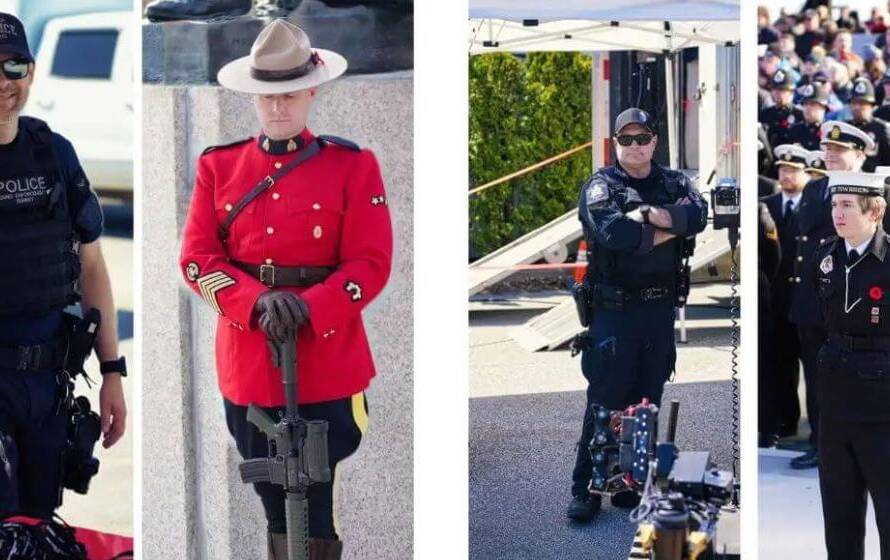


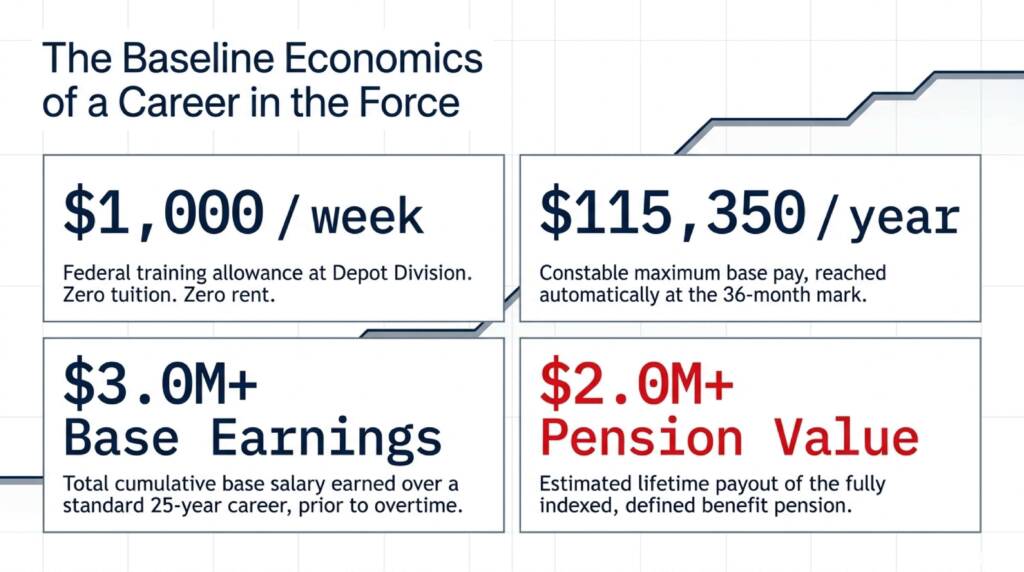
The RCMP salary starts at $71,191 for new constables after Depot and reaches $115,350 within 36 months on a Treasury Board pay grid. Cadets earn $1,000 per week in training as of April 2026. Base pay is national; net take-home and allowances vary by province and posting.
$71,191 → $115,350 — Constable base pay from graduation day to the 36-month ceiling under the 2026 collective agreement — automatic grid steps, not negotiated raises.
This RCMP salary guide covers cadet pay at Depot, the constable pay grid, paycheque math, after-tax take-home by province, benefits, pension value, and how RCMP pay compares with other Canadian police forces.
Estimate your take-home: Use the free RCMP salary calculator for paycheque math by rank, province, and deductions.Open RCMP Salary Calculator
For rank-by-rank detail, see RCMP salaries by rank and the constable pay grid.
This page covers the real numbers: what cadets earn at Depot, how the constable pay grid moves, what the RCMP salary looks like after tax in each province, how the pension adds up over a career, and how RCMP pay compares with major municipal forces in Canada.
Reality Check:
Most searches for RCMP salary stop at one annual number. In practice, cadet allowance, constable grid steps, isolated-post supplements, overtime, and the indexed pension sit on different schedules. Official pay tables list base rates; they rarely show net paycheque and total compensation in one place — which is why gross and take-home figures get mixed up in online comparisons.
What Is the RCMP Salary in 2026?
| Stage or Rank | Annual Pay |
|---|---|
| Depot cadet (training allowance) | $1,000 per week, about $26,000 over 26 weeks |
| Constable Level 1 (graduation day) | $71,191 |
| Constable Level 2 (after 6 months Field Coaching) | $92,497 |
| Constable Level 3 (12 months) | $100,356 |
| Constable Level 4 (24 months) | $108,220 |
| Constable maximum (36 months) | $115,350 |
| Corporal | $121,691 to $126,311 |
| Sergeant | $133,677 |
| Staff Sergeant | $146,019 |
| Sergeant Major | $150,524 |
| Inspector (commissioned) | about $125,000 to $160,000 |
| Superintendent | about $165,000 to $205,000 |
| Deputy Commissioner | $214,988 to $237,352 |
All figures reflect the National Police Federation (NPF) collective agreement in effect for 2026. The constable grid runs from hire through maximum in roughly 36 months, faster than most large municipal forces, which typically take four to seven years to reach first class constable rates. For a full rank-by-rank reference, see our encyclopedia of RCMP pay scales by rank.
What Is the RCMP Pay Scale?
The RCMP pay scale is the Treasury Board grid that sets base RCMP salary by rank and time in rank. You do not apply for these steps and you do not negotiate them. The National Police Federation collective agreement locks the rates in. The higher amount shows up on the next cheque when you hit each interval.
For constables the scale has five published points on this page. Level 1 on graduation day is $71,191, about $1,369 per week or $34.23 per hour on a 40 hour week. Level 2 after six months of Field Coaching is $92,497. That is the largest single jump, about $21,000 in base pay. Level 3 at 12 months is $100,356, the first six figure rate. Level 4 at 24 months is $108,220. The constable ceiling at 36 months is $115,350, about $55.46 per hour, $2,218 per week, or $9,613 per month. After that, base pay stays flat until promotion.
Cadet pay sits off this employee grid. Depot trainees receive a $1,000 weekly training allowance (about $26,000 over 26 weeks), up from $525 before April 1, 2026. They are federal trainees, not sworn members, until graduation. Above constable, the same national scale lists corporal at $121,691 to $126,311, sergeant at $133,677, staff sergeant at $146,019, and sergeant major at $150,524. Commissioned ranks on this page run from about $125,000 to $160,000 for inspector, about $165,000 to $205,000 for superintendent, and $214,988 to $237,352 for deputy commissioner. The constable portion of the scale reaches maximum in about 36 months. Most large municipal forces take four to seven years to reach first class constable rates. For the constable steps in more detail, see the constable pay grid. For every rank, see RCMP salaries by rank.
How Much Do RCMP Cadets Get Paid at Depot?
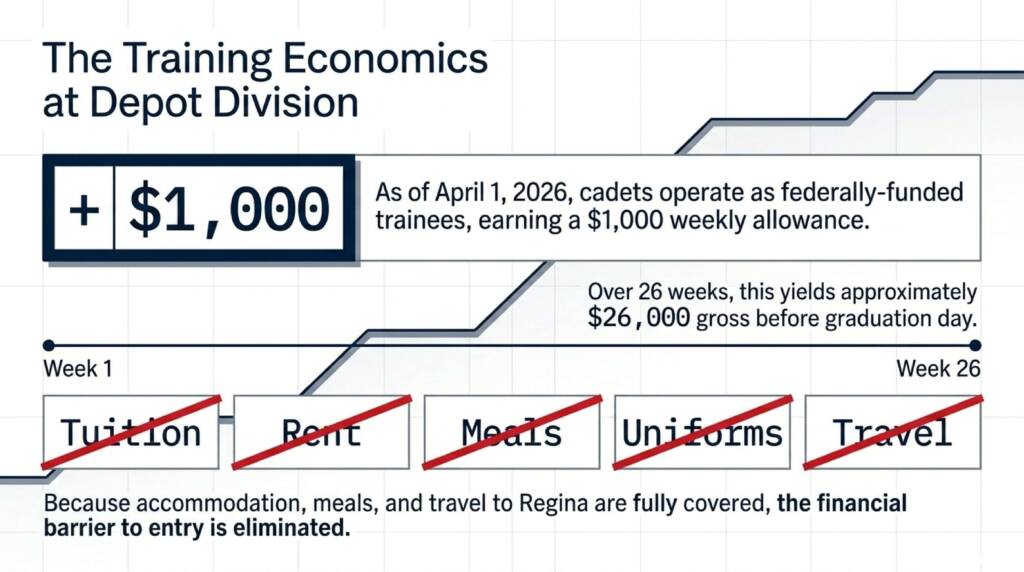
Cadets at Depot Division in Regina now earn a training allowance of $1,000 per week, up from $525 per week before April 1, 2026. Over the full 26 week Cadet Training Program that works out to about $26,000 gross. Accommodation, meals, uniforms, and travel to Regina are covered separately, so cadets pay no tuition and no rent.
The allowance is not regular employment income. Cadets are federal trainees, not sworn employees, and the full benefits package (pension, health, dental) kicks in on graduation day. More detail in our breakdown of the cadet training allowance bump to $1,000 a week and the broader overview at do RCMP recruits get paid during training.
How Fast Does RCMP Salary Increase?
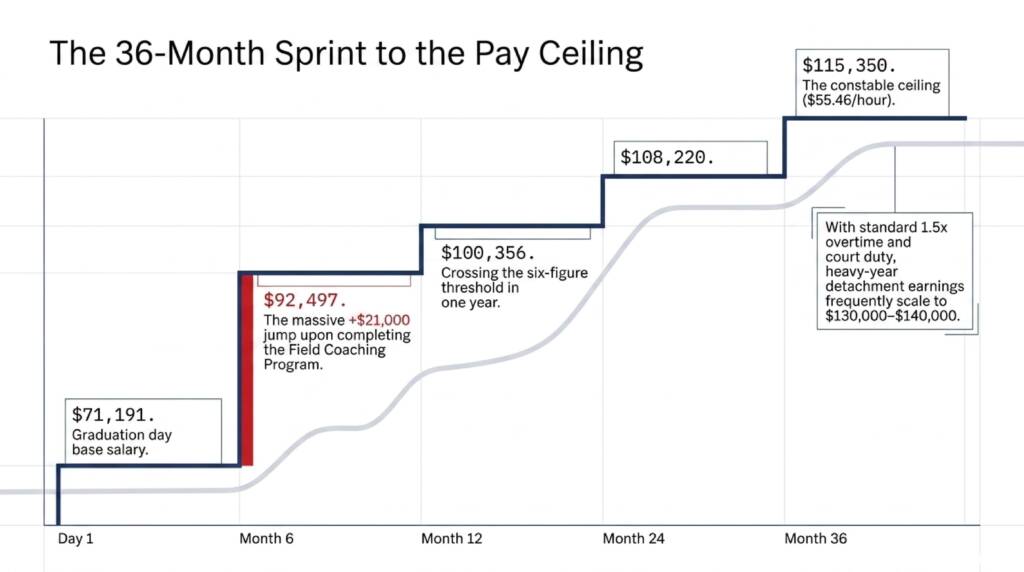
Constable pay moves on a pay grid. You do not apply for raises and you do not negotiate them. The collective agreement locks in automatic step increases at set intervals, and the higher rate appears on your next cheque.
- Day 1 (graduation): $71,191, about $1,369 per week
- After 6 months (Field Coaching complete): $92,497
- After 12 months: $100,356, the point where a new constable crosses into six figures
- After 24 months: $108,220
- After 36 months: $115,350, the constable ceiling
The single largest jump comes after the six month Field Coaching Program, a structured on the job period at your first posting. That move from Level 1 to Level 2 adds roughly $21,000 in base pay. Once you hit the constable ceiling of $115,350, base rates stay flat until promotion to corporal. Total earnings can still grow through overtime, callback pay, court duty, shift premiums, and remote posting allowances. For a full breakdown of the constable pay grid see: RCMP Constable Salary: Full Pay Grid and Progression
What Is the RCMP Salary per Hour, Week, and Month?
Most people searching RCMP pay want the paycheque math, not just the annual headline. Here is what the grid looks like for a standard 40 hour week, gross, before deductions.
| Level | Annual | Hourly | Weekly | Monthly |
|---|---|---|---|---|
| Constable Level 1 | $71,191 | $34.23 | $1,369 | $5,933 |
| Constable Level 3 (1 year) | $100,356 | $48.25 | $1,930 | $8,363 |
| Constable maximum | $115,350 | $55.46 | $2,218 | $9,613 |
| Sergeant | $133,677 | $64.27 | $2,571 | $11,140 |
Overtime is paid at 1.5 times the grid rate. A busy detachment constable at the pay ceiling can realistically earn $130,000 to $140,000 in a heavy year once overtime, court duty, and callback pay are added in.
Bi-weekly paycheque (gross): Level 1 is about $2,738 every two weeks; at the constable ceiling it is about $4,437 before tax, CPP, EI, and pension. RCMP payroll is typically bi-weekly, so monthly figures above are annual ÷ 12 for budgeting, not exact cheque amounts.
How Much Does an RCMP Corporal Earn?
An RCMP corporal earns $121,691 to $126,311 in base pay on the 2026 national grid. That range sits above the constable ceiling of $115,350 and below the sergeant rate of $133,677. Base pay is the same in every province. Take-home still changes with provincial tax, overtime, and Isolated Posts allowances.
You do not reach corporal by waiting out another automatic constable step. After 36 months, constable base pay stays flat until promotion. The career example on this page places promotion to corporal around year 8. The 25 year earnings table then assigns corporal years 9 to 14 about $745,000 in base pay for that period. Those figures are a planning model, not a promise that every member promotes on that timetable.
Total compensation is larger than the corporal band alone. Benefits for a constable at the pay ceiling with a family add roughly $25,000 to $35,000 in annual equivalent value before remote allowances. Isolated Posts and Government Housing supplements of $8,000 to $40,000 or more can apply on northern or remote postings. Overtime is paid at 1.5 times the grid rate. A bilingual bonus of $800 a year and education assistance up to $1,500 a year are also in the package. For rank-specific detail, see RCMP corporal salary.
How Much Does an RCMP Sergeant Earn?
An RCMP sergeant earns $133,677 in base pay on the 2026 grid. On a standard 40 hour week that is about $64.27 per hour, $2,571 per week, and $11,140 per month, gross, before tax, CPP, EI, and pension. The rate is national. Staff sergeant is the next published NCO step at $146,019, then sergeant major at $150,524.
The career example on this page places promotion to sergeant around year 15. Sergeant years 15 to 25 then contribute about $1,470,000 in base pay in that model, the largest single block in the 25 year table. Total base earnings across 25 years land around $2.7 million to about $3.0 million before overtime, allowances, and pension. Add roughly $250,000 to $500,000 in overtime, callback, and allowances across the same span if the posting is busy or remote.
Sergeant pay also drives pension math on this page. An officer who retires after 25 years at sergeant level, using about $133,677 as the best 5 year average, collects roughly $66,800 a year, fully indexed to the Consumer Price Index, for life. An unreduced pension is available at any age after 25 years of service. An officer who joins at 22 can retire with a full pension before 50. Across a typical 30 year retirement that indexed stream pays out another $2.0 million plus. For the rank page, see RCMP sergeant salary.
How Much Do RCMP Officers Take Home After Tax?
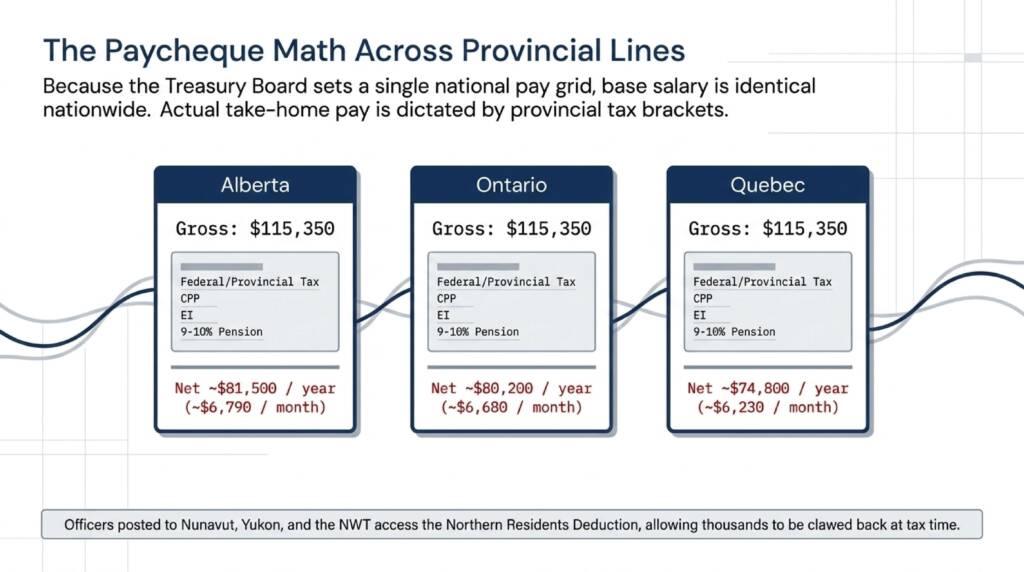
Gross pay is only half the story. After federal and provincial income tax, CPP, EI, and roughly 9 to 10 percent pension contributions, take home pay drops noticeably. Net figures below assume the 2026 federal brackets and single filer status with basic deductions only.
| Gross Salary | Province | Estimated Net (per year) | Estimated Net (per month) |
|---|---|---|---|
| $71,191 (new constable) | Alberta | ~$53,400 | ~$4,450 |
| $71,191 (new constable) | British Columbia | ~$52,900 | ~$4,410 |
| $71,191 (new constable) | Ontario | ~$52,600 | ~$4,380 |
| $115,350 (constable max) | Alberta | ~$81,500 | ~$6,790 |
| $115,350 (constable max) | Ontario | ~$80,200 | ~$6,680 |
| $115,350 (constable max) | Quebec | ~$74,800 | ~$6,230 |
| $115,350 (constable max) | Saskatchewan | ~$80,900 | ~$6,740 |
| $115,350 (constable max) | Nova Scotia | ~$79,600 | ~$6,630 |
Quebec shows a lower net because provincial income tax is the highest in Canada. On the flip side, members posted to Nunavut, Yukon, and the Northwest Territories get the Northern Residents Deduction on top of regular tax filing, which can claw a few thousand dollars back at tax time.
Is the RCMP Salary Competitive?
Compared with the median Canadian full time salary of roughly $65,000 to $70,000, a third year RCMP constable at $115,350 is well above average. Compared with other careers that demand similar training and risk, such as nursing, engineering, and skilled trades, the RCMP officer salary is competitive and usually ahead once benefits are included.
The honest comparison is other Canadian police forces. At the starting line RCMP sits in the middle of the national range, below top paying GTA regional forces but level with most provincial and municipal departments. Where RCMP pulls ahead is the speed to the pay ceiling, the Isolated Posts allowance system, and the quality of the pension. For a comprehensive look at whether the overall compensation package holds up against other professional careers in Canada, including trades, nursing, and corporate roles, see the full breakdown.
What Benefits Come With an RCMP Salary?
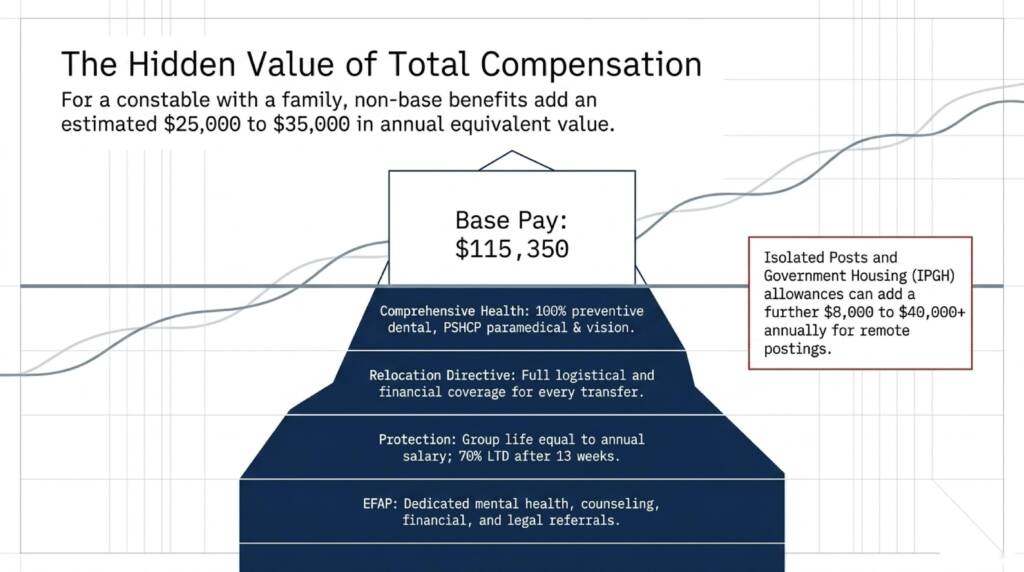
Base pay is only part of total compensation. The full RCMP package also includes:
- Health care: Public Service Health Care Plan (PSHCP) for prescriptions, paramedical, vision, and travel emergency medical.
- Dental: 100 percent coverage for preventive care; 50 to 80 percent for restorative work.
- Life and disability insurance: Basic group life equal to annual salary, plus long term disability covering 70 percent of pay after 13 weeks.
- Employee and Family Assistance Program (EFAP): Counselling, mental health, financial and legal referrals.
- Relocation assistance: Full National Joint Council Relocation Directive coverage for every posting transfer.
- Isolated Posts and Government Housing (IPGH) allowances: Supplements of $8,000 to $40,000 or more for remote and northern postings.
- Bilingual bonus: Extra $800 a year for certified bilingual members.
- Education assistance: Up to $1,500 a year for continuing education.
- Vacation: 15 days starting, moving to 30 after 23 years of service.
For a constable at the pay ceiling with a family, these benefits add roughly $25,000 to $35,000 in annual equivalent value before any remote allowances are counted.
How Much Is the RCMP Pension Worth?
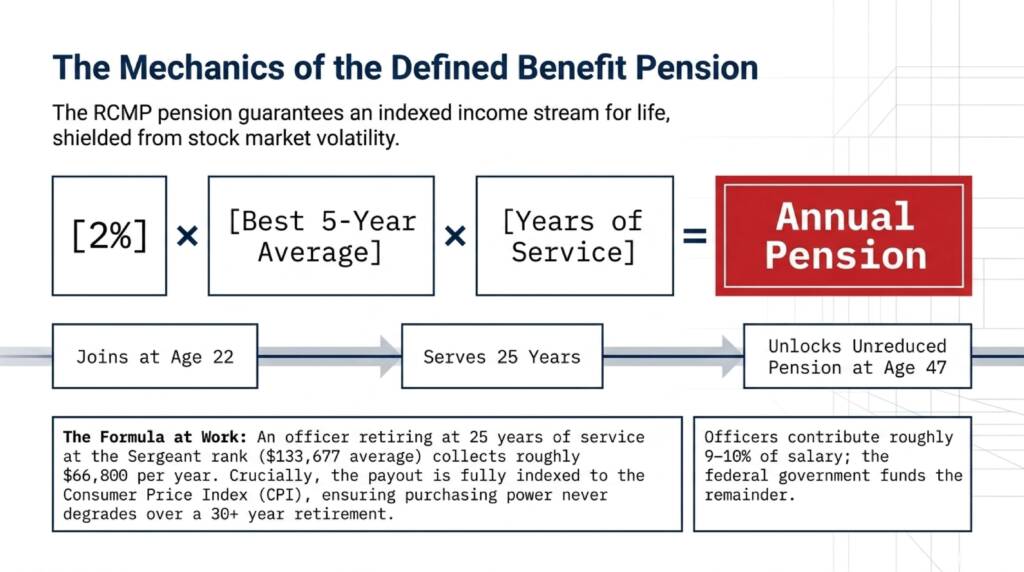
The RCMP pension is a defined benefit plan. The formula is 2 percent times best 5 year average salary times years of pensionable service, up to a 35 year maximum. An officer who retires after 25 years at sergeant level (about $133,677 best 5 average) collects roughly $66,800 a year in pension, fully indexed to the Consumer Price Index, for life.
An unreduced pension is available at any age after 25 years of service. An officer who joins at 22 can retire with a full pension before 50. Officers contribute roughly 9 to 10 percent of salary; the federal government covers the rest.
Most private sector salary comparisons ignore the pension. Across a full retirement, the indexed pension stream is worth hundreds of thousands of dollars, and the payout is guaranteed instead of market dependent.
JoinRCMP Observation:
Most RCMP salary comparisons stop at the annual base figure. That approach consistently understates the real compensation picture. The indexed defined benefit pension alone is worth hundreds of thousands of dollars in lifetime payout that no annual salary figure captures. An officer who joins at 22 and retires after 25 years at sergeant level could draw roughly $66,800 a year from age 47, fully indexed to CPI, for life. No private sector comparison and no municipal force comparison is accurate if it leaves the pension out of the equation.
How Much Does an RCMP Officer Earn Over a Career?
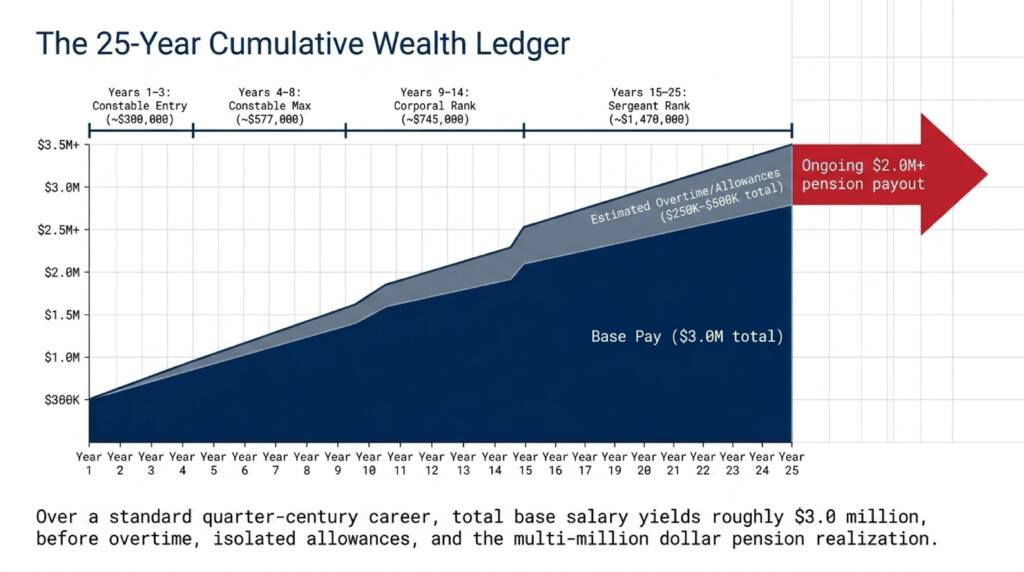
For career planning, the annual headline is less useful than the lifetime total. Assuming a member joins at 22, hits the constable ceiling at 25, promotes to corporal at around year 8, and to sergeant at year 15, the total base salary earned over 25 years of service lands around $2.7 million before overtime, allowances, and the pension.
| Career Stage | Years | Base Pay in Period |
|---|---|---|
| Constable Level 1 to 5 | 1 to 3 | about $300,000 |
| Constable maximum (flat) | 4 to 8 | about $577,000 |
| Corporal | 9 to 14 | about $745,000 |
| Sergeant | 15 to 25 | about $1,470,000 |
| Total base over 25 years | around $3.0 million |
Add roughly $250,000 to $500,000 in overtime, callback, and allowances across the same 25 years, then layer the indexed pension on top of that (about $66,800 a year starting at age 47). The pension alone pays out another $2.0 million plus over a typical 30 year retirement.
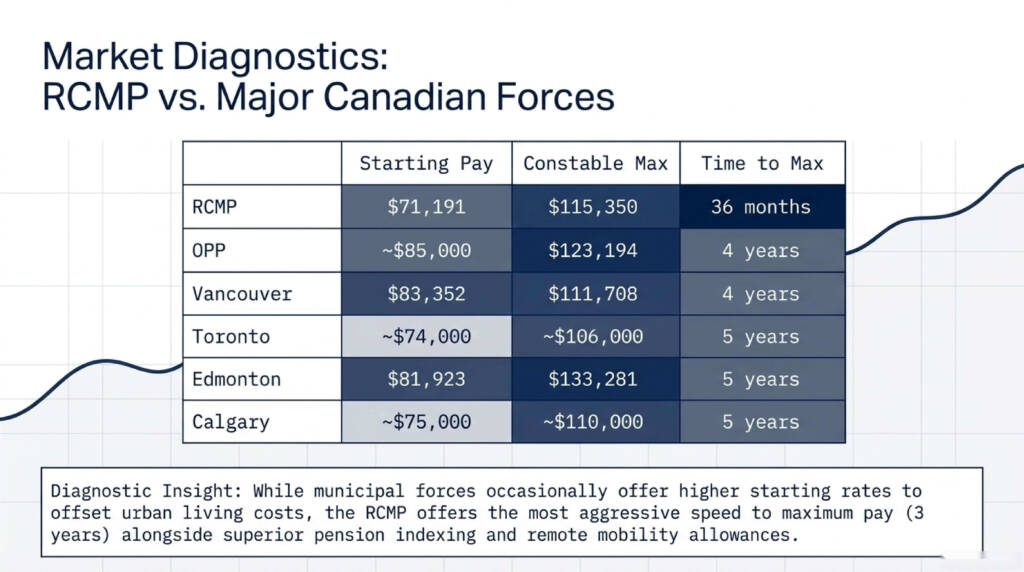
How Does RCMP Salary Compare to Other Canadian Police?
At the base level, RCMP constables earn roughly the same as most Canadian police forces at their respective pay ceilings. The notable exceptions are GTA regional forces such as York Regional and Peel Regional, where first class constables can clear $118,000 to $123,000, slightly above the RCMP maximum of $115,350.
| Police Force | Starting | Max Constable | Time to Max |
|---|---|---|---|
| RCMP | $71,191 | $115,350 | 36 months |
| Ontario Provincial Police (OPP) | about $85,000 | $123,194 | 4 years |
| Vancouver Police | $83,352 | $111,708 | 4 years |
| Toronto Police | about $74,000 | about $106,000 | 5 years |
| Edmonton Police | $81,923 | $133,281 | 5 years |
| Calgary Police | about $75,000 | about $110,000 | 5 years |
Where RCMP wins: faster progression to max pay, CPI indexed pension (some municipal pensions offer only partial indexing), remote posting allowances, and fully covered relocation on every transfer. Where municipal forces win: posting stability in one city and sometimes higher starting pay to offset urban cost of living. For a detailed side-by-side breakdown: RCMP Salary vs OPP, Toronto Police and Vancouver Police
Does RCMP Salary Vary by Province?
Base RCMP salary is identical in every province because the national collective agreement sets one pay grid. What changes is total compensation, driven by posting type and provincial tax. Officers in northern Canada and isolated communities receive IPGH allowances that push take home noticeably higher.
In practice, a constable posted to Iqaluit, Inuvik, or a remote Indigenous community can take home $25,000 to $45,000 more per year than the same constable in Surrey or Edmonton, before counting cost of living differences. British Columbia and Ontario offer the largest urban detachments but the lowest effective pay gap versus other forces in the same market. Quebec nets out lowest on after tax pay due to provincial tax rates.
What Was the 2023-2024 RCMP Pay Raise?
In 2024 an arbitration board awarded roughly 20,000 unionized RCMP members an 8 percent compounded raise across two years: 4 percent retroactive to April 1, 2023, and another 4 percent on April 1, 2024. The figures on this page already reflect those increases. Another round of negotiations is expected before the end of the current agreement, which runs through 2026. For the official rates of pay, see the Treasury Board of Canada page for RCMP Regular Members rates of pay and the RCMP pay and benefits page (rcmp.ca).
How Do You Start Earning the RCMP Salary?
You only collect the RCMP salary after passing recruitment. The full application process runs 8 to 16 months and includes eligibility screening, the Online Entrance Assessment (OEA), fitness testing, a suitability interview, a background investigation, and 26 weeks at Depot in Regina.
Start with the pillar pages below:
- RCMP eligibility requirements
- RCMP recruitment overview
- The RCMP application process, step by step
- How long Depot training actually lasts
Frequently Asked Questions
What is the starting RCMP salary in 2026?
New constables earn $71,191 after Depot. Cadets get $1,000 per week in training.
What is the maximum RCMP constable salary?
The constable ceiling is $115,350, reached about 36 months after graduation.
Do RCMP recruits get paid during training?
Yes. Cadets receive $1,000 per week. Meals, housing, and travel to Regina are covered.
How much is RCMP salary per hour?
At $115,350 maximum, about $55.46 per hour before overtime on a 40-hour week.
Explore Every RCMP Salary Topic
Pay Basics
- RCMP Salaries by Rank in Canada (Complete Guide)
- RCMP Salary vs OPP, Toronto Police and Vancouver Police
- Is the RCMP salary competitive? A full assessment
Pay by Rank
- RCMP Cadet Training Allowance: $1,000 a Week
- Do RCMP Recruits Get Paid During Training?
- RCMP Constable Salary: Full Pay Grid and Progression
- RCMP Corporal Salary
- RCMP Sergeant Salary
- RCMP ERT Salary: Emergency Response Team Pay
Sources
This article reflects current RCMP compensation policy based on official government documentation. Eligibility, suitability, and individual pay may be assessed on a case-by-case basis during recruitment and service.
- RCMP — Salary and benefits (rcmp-grc.gc.ca)
- Treasury Board — RCMP Regular Members rates of pay (canada.ca)
- RCMP pay and benefits overview (rcmp.ca)
Salary figures reflect the current RCMP Regular Members collective agreement and the April 2026 cadet training allowance. Individual take-home may vary by province, allowances, overtime, and payroll deductions. Net pay estimates are illustrative; use an up-to-date Canadian income tax calculator for your own filing.