

RCMP Jobs in Canada: Salaries, Requirements and How to Apply
Quick Answer: The RCMP employs over 42,000 people in three categories: Regular Members (sworn officers), Civilian Members, and Public Service employees. Constables start at $71,191 and reach $115,350 within 36 months. With 3,400+ vacancies in 2026, applications are open across 712 detachments in 13 provinces and territories.
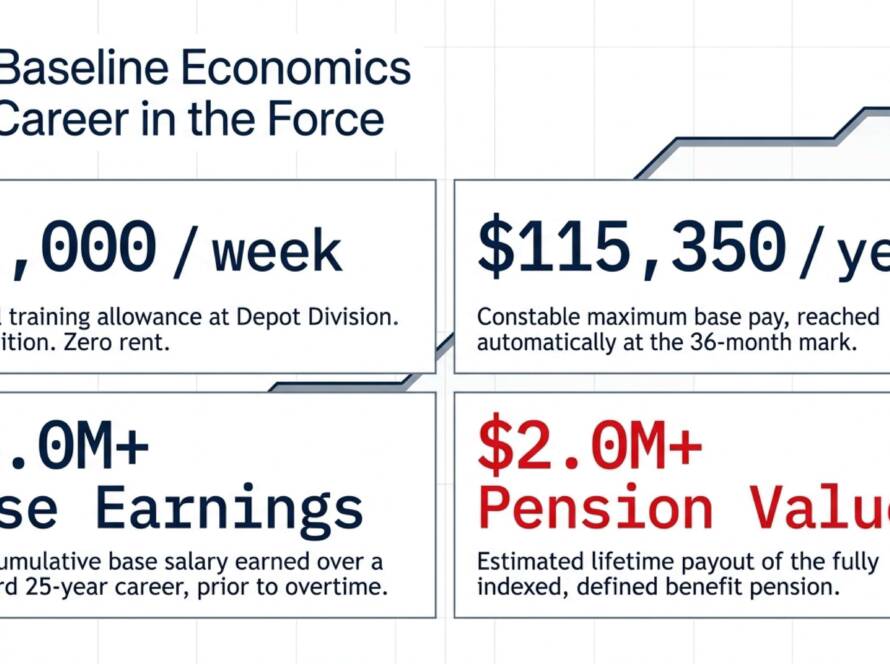
RCMP jobs fall into three categories: Regular Members (sworn police officers), Civilian Members, and Public Service employees. The Royal Canadian Mounted Police employs more than 42,000 people across 712 detachments in 13 provinces and territories, with over 150 career specializations available inside a single organization. Applications are open in 2026. New constables start at $71,191 and reach $115,350 within 36 months of service.
This guide covers every type of RCMP job, what you need to qualify, what you will earn, and how to apply.
For the full application walkthrough, see our how to join the RCMP guide.
What Are RCMP Jobs?
The Royal Canadian Mounted Police is Canada’s national police service and one of the country’s largest law enforcement employers. The force operates 15 divisions and serves 11 provinces and territories — all of Canada except Ontario and Quebec, which have their own provincial police forces. Across those divisions, the RCMP polices more than 150 municipalities and works alongside more than 600 Indigenous communities through 712 detachments.
A career with the RCMP offers more than 150 specializations inside a single organization. Officers move between general duty policing, federal investigations, organized crime, cybercrime, national security, border integrity, and specialized units over the course of a career. That range of work is what sets the RCMP apart from most other Canadian police services, where officers often stay within a single municipality their entire career.
Three Types of RCMP Jobs
The RCMP employs people in three distinct categories. Each has different hiring rules, different duties, and a different career path.
Regular Members
Regular Members are sworn police officers hired under the RCMP Act. They carry full police powers: making arrests, executing warrants, conducting criminal investigations, and enforcing federal, provincial, and municipal laws wherever the RCMP holds jurisdiction. All new Regular Members complete 26 weeks of residential training at Depot Division in Regina, Saskatchewan, before being posted to a detachment anywhere in Canada.
Civilian Members
Civilian Members are hired under the RCMP Act but are not sworn police officers. They hold specialized technical and support roles that directly back police operations — positions that require professional expertise a general-duty officer typically does not have.
Public Service Employees
Public Service employees are hired under the Public Service Employment Act. These positions are posted through GC Jobs and cover administrative, technical, and professional functions. The RCMP lists the following types of civilian and public service roles: 9-1-1 dispatcher, ATIP analyst, administrative support, air and marine operations, civilian criminal investigator, community and cultural affairs, criminal intelligence, forensics, human resources, IT and core services, law, psychologist, research and analysis, software engineer, technician, and wellness and safety.
For a full breakdown of non-officer career paths, see the guide to RCMP careers in Canada.
The officer track requires no prior police experience whatsoever — Depot is designed to build officers from scratch. And for Civilian Member and Public Service roles, the requirement is professional expertise in the specific field: IT, law, psychology, forensics, dispatch. The RCMP actively recruits from outside policing. Prior military or security experience may strengthen an application in some streams, but it is never a prerequisite for any entry-level RCMP position.
RCMP Job Requirements
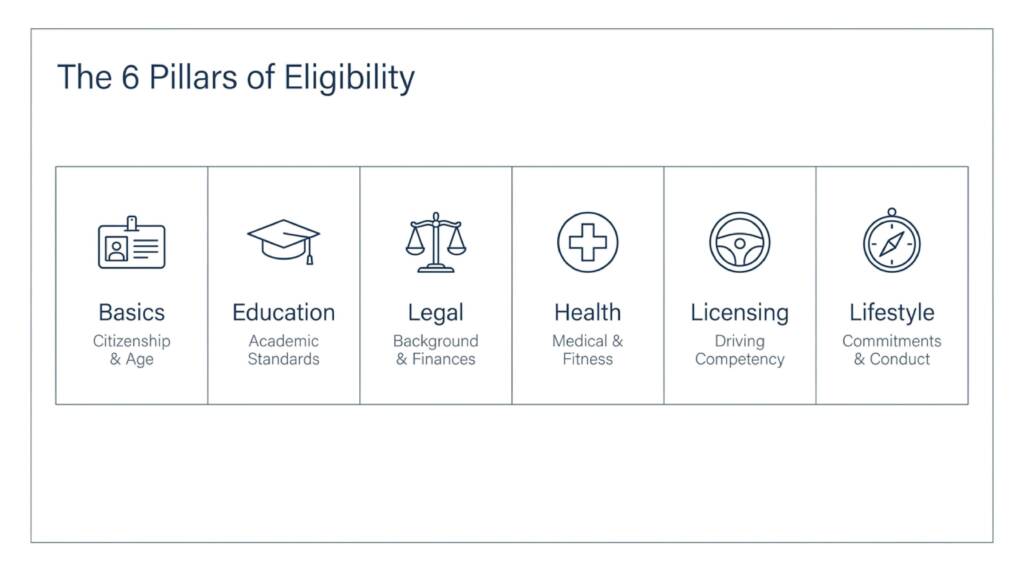
To become a Regular Member, you must meet eligibility criteria set federally by the RCMP. The same checklist applies whether you are applying in British Columbia or New Brunswick.
| Requirement | Details |
|---|---|
| Citizenship | Canadian citizen or permanent resident. Permanent residents must have lived in Canada for at least 3 of the last 5 years (1,095 days) while holding PR status. |
| Age | At least 18 to apply; cannot be hired until age 19. No maximum age limit. |
| Education | Canadian secondary school diploma or equivalent. No university degree is required. |
| Language | Proficient in English or French. Bilingualism is not required to apply. |
| Driver’s licence | Valid, unrestricted Canadian driver’s licence. |
| Health | Meet RCMP health, vision, hearing, and psychological standards. |
| Fitness | Pass the Police Fitness Assessment (PFA) — replaced the PARE as of April 1, 2024. |
| Criminal record | No criminal convictions without a pardon or records suspension. No serious criminal behaviour. No criminal activity within one year of applying. |
| Availability | Willing to train for 26 weeks at Depot in Regina. Willing to relocate anywhere in Canada. Willing to work shift work. |
No maximum age limit applies to RCMP applications. For a full walkthrough of all eligibility criteria, see the RCMP eligibility guide.
Many applicants approach RCMP jobs as they would a private-sector job search: identify a target city, apply, and negotiate. The RCMP does not work that way. New Regular Members are assigned to their first posting based entirely on operational need. The Flexible Posting Plan was phased out in July 2025. That means a candidate who applies from Vancouver or Toronto has no guarantee of staying near those cities. Most new graduates are posted to rural detachments in Western Canada or the territories. The career offers exceptional breadth and variety precisely because postings change. The tradeoff is that stability of place is not part of the early-career deal.
RCMP Salary in 2026
RCMP constables earn between $71,191 and $115,350 per year, with structured increases tied to time in service rather than performance reviews. The pay scale is set through the collective agreement between the National Police Federation and Treasury Board.
| Stage | Annual Salary |
|---|---|
| Upon graduation from Depot | $71,191 |
| 6 months of service (Field Coaching complete) | $92,497 |
| 12 months of service | $100,356 |
| 24 months of service | $108,220 |
| 36 months of service (constable maximum) | $115,350 |
Officers who promote beyond constable move into a separate pay grid. Corporals earn $121,691 to $126,311 annually. Sergeants earn $133,677. Officers at the Inspector level and above are paid on a separate commissioned officer scale.
Beyond base pay, RCMP officers receive a defined benefit pension (2% x best 5-year average salary x years of service), full health and dental coverage, group life insurance, remote and isolated posting allowances of $8,000 to $40,000+ per year, and relocation assistance when posted. Bilingual officers receive an annual $800 bilingual allowance on top of base pay.
For the complete pay breakdown by rank and year of service, see the RCMP salary hub. For the rank-by-rank reference table, see RCMP salaries by rank in Canada.
Is the RCMP Hiring Right Now?
Yes. The RCMP is actively accepting applications in 2026 and the recruitment shortfall is at a critical level. In March 2026, the Office of the Auditor General of Canada published findings showing the RCMP needed at least 3,400 additional officers as of September 2025 to meet operational requirements across the force.
The same audit found vacancy rates above the critical 7% threshold in 9 of 11 provinces and territories the RCMP polices. The RCMP missed its target application processing time for 97% of applications. Applications are open. Candidates who are prepared and submit strong files are entering a force that urgently needs them. For detailed intake targets, vacancy rates by division, and processing timeline data, see Is the RCMP Hiring in 2026.
How to Apply for RCMP Jobs
The Regular Member application process runs through nine official stages. Most candidates take between 12 and 18 months from first application to Depot start date.
- Submit an online application through the RCMP careers portal at rcmp.ca/en/careers-rcmp.
- Watch the career presentation video — required before moving forward.
- Complete the Online Entrance Assessment (OEA) — 55 to 70 minutes across six sections, completed remotely within 14 days of receiving the link.
- Submit required forms and documents — identity documents, education records, employment history, and reference contacts. Start gathering these early.
- Complete a suitability interview — the Attribute Evaluation Interview (four behavioural competencies) and the RMAQ review (complete personal history).
- Undergo medical and psychological assessments — physician review and Psychological Suitability Screening.
- Undergo a field investigation and security assessment — 10-year background check plus pre-employment polygraph.
- Receive a conditional offer — if you clear all stages, you enter the queue for a Depot start date.
- Attend Depot Division — 26 weeks of residential training in Regina, Saskatchewan.
For Civilian Member and Public Service roles, search jobs.gc.ca and filter by “Royal Canadian Mounted Police” as the hiring department.
The RCMP application is closer to a federal security clearance process than a job application. Applicants who treat it casually — vague reference contacts, incomplete employment history, undisclosed past issues — create delays or disqualifications that a complete, upfront file would have avoided. Disclose everything honestly at the outset. The field investigation will surface it regardless. Applicants who are straightforward with investigators consistently report smoother experiences than those who try to minimize or omit.
RCMP Jobs by Province
The RCMP organizes its operations into 15 divisions, each covering a specific province or territory. All applications go through the same national portal. The RCMP assigns postings based on operational need — you do not apply to a specific province or detachment.
| Division | Province or Territory | Headquarters |
|---|---|---|
| National | National Capital Region | Ottawa, ON |
| B Division | Newfoundland and Labrador | St. John’s, NL |
| C Division | Quebec | Montreal, QC |
| D Division | Manitoba | Winnipeg, MB |
| E Division | British Columbia | Surrey, BC |
| F Division | Saskatchewan | Regina, SK |
| G Division | Northwest Territories | Yellowknife, NT |
| H Division | Nova Scotia | Halifax, NS |
| J Division | New Brunswick | Fredericton, NB |
| K Division | Alberta | Edmonton, AB |
| L Division | Prince Edward Island | Charlottetown, PEI |
| M Division | Yukon | Whitehorse, YT |
| O Division | Ontario | London, ON |
| V Division | Nunavut | Iqaluit, NU |
| Depot | Training Academy | Regina, SK |
The RCMP does not provide provincial policing in Ontario or Quebec — those provinces have the Ontario Provincial Police and the Sûreté du Québec. The RCMP still operates in both provinces for federal policing mandates, Indigenous communities, and select municipalities.
| Province or Territory | Detachments |
|---|---|
| British Columbia | 154 |
| Alberta | 119 |
| Saskatchewan | 113 |
| Manitoba | 88 |
| Nova Scotia | 53 |
| New Brunswick | 44 |
| Newfoundland and Labrador | 43 |
| Nunavut | 26 |
| Northwest Territories | 22 |
| Ontario | 16 |
| Quebec | 14 |
| Yukon | 14 |
| Prince Edward Island | 6 |
The question candidates most often get wrong is “where will I be posted?” They plan around a city. The RCMP doesn’t negotiate first postings — operational need determines placement, and most new graduates end up in rural or northern detachments. The candidates who thrive are the ones who stop treating posting location as a variable they control and start treating it as part of the deal. The force offers exceptional variety across those 712 detachments. The tradeoff is that you go where you’re needed first.
Frequently Asked Questions
No. The RCMP has no maximum age limit. You must be 18 to apply and 19 to be hired — no upper cutoff.
New constables earn $71,191 at Depot graduation and reach $115,350 within 36 months. Pension, health, and dental are included.
Depot Division runs 26 weeks in Regina. Total time from first application to sworn officer averages 12–18 months.
Not automatically. Remote and isolated postings often include subsidized housing plus allowances of $8,000–$40,000+ per year.
Yes. Permanent residents must have lived in Canada for at least 1,095 days (3 of the last 5 years) while holding PR status.
The RCMP holds federal, provincial, and municipal jurisdiction simultaneously and can post officers anywhere in Canada — unlike city forces.
Sources:
Regular member recruitment | Royal Canadian Mounted Police
Regular member hiring process | Royal Canadian Mounted Police
This article reflects current RCMP policy based on official government documentation. Eligibility and suitability decisions are assessed on a case-by-case basis during the application process.