

What is the psych test for RCMP?
For the full application walkthrough, see our how to join the RCMP guide.
What is the psych test for RCMP?
Quick Answer:By Emily Clarke, Communications Specialist
The RCMP psychological test is called the Psychological Suitability Screening (PSS), a mandatory evaluation consisting of standardized written personality tests (like the MMPI-2), a pre-interview questionnaire, and a face-to-face clinical interview with a licensed psychologist to assess emotional stability, integrity, and fitness for policing duties.
The journey to becoming an RCMP officer involves one of the most thorough selection processes in Canadian law enforcement. At the heart of this process lies the psychological evaluation—a critical gateway that determines whether candidates possess the mental and emotional fortitude required for frontline policing.
The RCMP process is staged — delays usually come from document gaps, medical backlog, or security screening, not from a single “failed” step. Track each stage and fix blockers before they compound.
Understanding the Psychological Suitability Screening
The Psychological Suitability Screening represents far more than a simple pass-or-fail test. Think of it as a full audit of your psychological readiness for one of the country’s most demanding careers. The RCMP covers all costs associated with this assessment, recognizing its importance in building a resilient, effective police force.
This evaluation doesn’t merely screen out candidates with mental health concerns. Instead, it actively seeks to identify those who possess uncommon qualities: emotional resilience under extreme stress, unwavering ethical standards, sound judgment in chaotic situations, and the interpersonal skills needed to serve diverse communities across Canada.
The Three-Part Assessment Structure
The PSS unfolds through three interconnected components, each designed to evaluate different aspects of your psychological suitability.
Standardized Psychological Testing
The first component involves computerized written tests that measure personality traits and detect potential psychological concerns. The most commonly used instrument is the Minnesota Multiphasic Personality Inventory-2 (MMPI-2), a thorough assessment tool trusted across high-stakes professions including aviation, nuclear energy, and law enforcement worldwide.
This isn’t a test you can study for in the traditional sense. The MMPI-2 contains hundreds of true-or-false statements designed to build a detailed personality profile. Questions might ask you to agree or disagree with statements about your behavior, feelings, and attitudes. The test includes built-in validity scales that detect inconsistent responding or attempts to present yourself unrealistically.
Other instruments may include the Personality Assessment Inventory (PAI), the 16 Personality Factors Questionnaire (16PF), and the NEO Personality Inventory (NEO-PI-R). Each measures different dimensions of normal personality functioning relevant to police work.
The testing typically takes several hours to complete. You’ll answer questions honestly and consistently, understanding that these tools are sophisticated enough to identify when someone tries to “game” the system.
Pre-Interview Questionnaire and Documentation
Before meeting with the psychologist, you’ll complete a detailed Pre-Interview Questionnaire. This document requires full disclosure of your psychological and psychiatric history, including any past diagnoses, medications, therapy, or mental health concerns.
Here’s the critical point: accuracy and completeness are non-negotiable. Serious gaps, omissions, or inaccuracies can result in immediate termination of your application. The questionnaire serves as both an information-gathering tool and an integrity check.
The psychologist also reviews collateral information gathered throughout your RCMP recruitment journey. This includes data from suitability interviews, polygraph results, reference checks, background investigations, and any prior psychological assessments. This integrated approach—sometimes called the “intelligence-led” recruitment model—makes sure there is consistency across all evaluation points.
The Clinical Interview
The capstone of the PSS is your interview with a licensed psychologist designated by the RCMP. Unlike the structured suitability interview you completed during the RCMP application process, this clinical interview is adaptive and diagnostic.
The interview typically includes two distinct parts. First, a clinical follow-up explores issues identified in your written test results. The psychologist may ask you to clarify responses or discuss patterns that emerged from the testing.
Second, you’ll participate in a structured stress interview. Here, the psychologist asks you to describe past situations involving significant stress, conflict, or ethical challenges. The goal isn’t to judge whether your past was perfect—everyone faces difficulties. Instead, the evaluation focuses on how you responded emotionally, behaviorally, and cognitively to those challenges.
Did you seek healthy solutions or destructive ones? Did you learn from mistakes? Can you maintain composure when recalling stressful events? These insights reveal your stress tolerance and emotional self-regulation—critical attributes for police officers who regularly face traumatic situations.
What the Assessment Evaluates
The psychological screening examines several core competencies essential for effective policing. Understanding these can help you recognize what evaluators are looking for.
Emotional Stability and Stress Tolerance: Police work involves regular exposure to traumatic events, verbal abuse, and life-threatening situations. The assessment gauges your ability to remain calm, focused, and effective under extreme pressure without becoming overwhelmed or reactive.
Ethical Accountability and Integrity: Officers hold significant power and public trust. The evaluation probes your moral compass, honesty, and willingness to take responsibility for mistakes. Even minor dishonesty during the assessment can be disqualifying.
Interactive Communication Skills: Policing requires clear communication with diverse populations, from distressed victims to hostile suspects. The assessment evaluates your interpersonal skills, empathy, and ability to de-escalate tense situations through effective dialogue.
Teamwork and Reliability: RCMP officers depend on their colleagues for safety and mission success. The evaluation measures your ability to work collaboratively, follow directions, and contribute positively to team dynamics.
Problem-Solving and Adaptability: No two police calls are identical. The assessment examines your cognitive flexibility, decision-making process, and ability to adapt strategies when initial approaches don’t work.
Risk Management Capabilities: Officers must assess danger accurately and respond proportionately. The evaluation looks at your judgment, impulse control, and ability to balance assertiveness with restraint.
Mental Health Considerations
The RCMP reviews various psychological and psychiatric conditions during assessment, including mood disorders like depression and bipolar disorder, anxiety disorders including panic disorder and phobias, stress-related conditions such as PTSD, psychotic disorders, personality disorders, substance use disorders, neurodevelopmental conditions like ADHD and autism spectrum disorder, and obsessive-compulsive disorder.
However, here’s what many candidates misunderstand: having a mental health history doesn’t automatically disqualify you. The assessment may find you psychologically suitable even if you’ve faced psychological difficulties in the past, provided you can document successful functioning and stability over time.
Conversely, the evaluation may conclude you’re not psychologically suitable even without any diagnosable mental illness. Suitability hinges on whether you can handle the emotional, cognitive, and ethical demands of RCMP duties, not simply the presence or absence of a diagnosis.
Real-World Application: Why This Matters
Consider what RCMP officers face during their careers. You might respond to a fatal vehicle collision where children are involved, requiring you to provide professional service while managing your own emotional response. You could work in a remote northern community where the nearest backup is hours away, demanding extreme independence and sound judgment.
Officers regularly make split-second decisions with profound consequences—when to draw a firearm, how to respond to a mental health crisis, whether to pursue a fleeing suspect. These situations don’t allow time for consultation or second-guessing. The psychological assessment attempts to predict how you’ll perform in these crucibles.
This explains why the RCMP maintains such rigorous standards. A selection error in policing doesn’t just cost productivity—it can result in constitutional violations, excessive force incidents, loss of life, or erosion of public trust. The psychological screening serves as a critical firewall protecting both the public and the organization.
Common Challenges and Misconceptions
Many candidates struggle with the concept that honesty might reveal unflattering truths. They worry that admitting to past mistakes, minor anxiety, or occasional anger will doom their application. This creates a paradox: being too perfect raises red flags (the test detects this), but being too forthcoming feels risky.
The solution lies in understanding what evaluators call the “healthy V profile.” Successful candidates acknowledge common human experiences—occasional stress, normal frustration, minor conflicts—while clearly demonstrating they don’t engage in destructive behaviors or hold concerning attitudes. You’re not claiming perfection; you’re showing realistic self-awareness combined with sound judgment.
Another misconception involves trying to guess “correct” answers. The MMPI-2 and similar instruments contain hundreds of items precisely to prevent this. Consistency matters more than any individual response. If you claim to never feel angry but later endorse items about losing your temper, the test flags this contradiction.
Preparing for Success
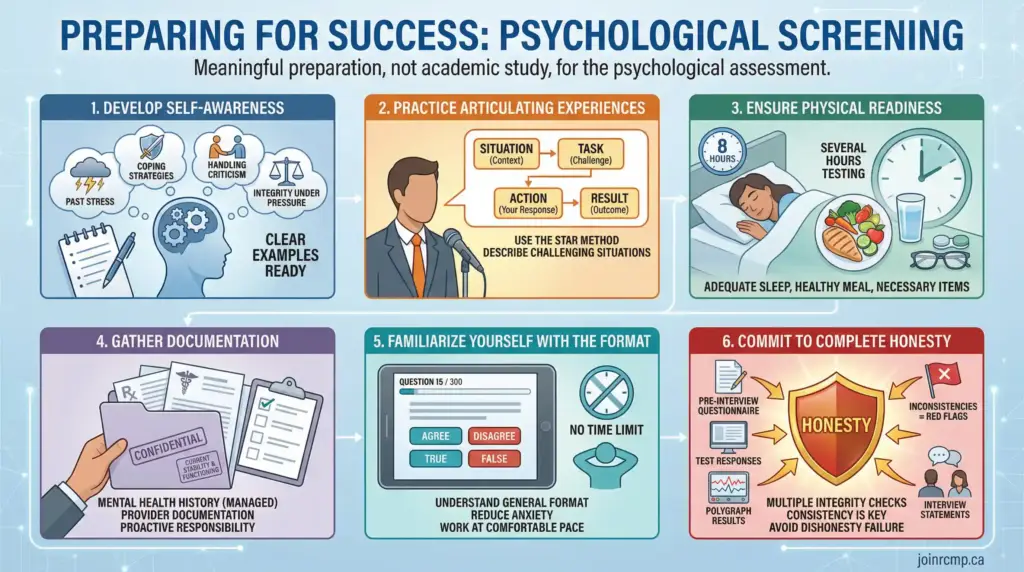
While you can’t study for personality testing like an academic exam, you can prepare meaningfully for the psychological screening.
Develop Self-Awareness: Reflect on your responses to past stressful situations. What coping strategies do you use? How do you handle criticism? When have you demonstrated integrity under pressure? Having clear examples ready helps in the interview portion.
Practice Articulating Your Experiences: The clinical interview requires you to describe challenging situations and your responses. Practice explaining these using the STAR method (Situation, Task, Action, Result) you learned during your suitability interview preparation.
Make Sure You’re Physically Ready: Get adequate sleep before testing day. Eat a healthy meal. Bring necessary items like glasses or contact lenses. The testing session can last several hours, and fatigue affects your responses.
Gather Documentation: If you have a history of mental health concerns that have been successfully managed, compile documentation from healthcare providers showing your current stability and functioning. This prepared approach demonstrates responsibility.
Familiarize Yourself With the Format: While specific test questions are protected, understanding the general format helps reduce anxiety. You’ll encounter many agree-disagree or true-false statements. There’s no time limit, so you can work at a comfortable pace.
Commit to Complete Honesty: This cannot be overstated. The assessment includes multiple integrity checks. Inconsistencies between your Pre-Interview Questionnaire, test responses, polygraph results, and interview statements raise immediate red flags. Many candidates fail not due to psychological unsuitability but due to dishonesty.
The Path Forward After Assessment
After completing your psychological screening, you won’t receive immediate results or feedback. The psychologist compiles a detailed report for the RCMP Health Services Officer, who then assigns you a medical profile determining your fitness for duty.
Candidates must sign a consent form acknowledging they won’t receive access to reports, test results, or detailed feedback following the screening. This protects test security and makes sure future candidates cannot coach their responses based on specific items or scoring methods.
If you’re found psychologically suitable, you’ll advance to the Medical Screening Process, which assesses your overall physical fitness for duty. Successfully completing both evaluations moves you significantly closer to your goal of joining the RCMP.
If you’re deemed unsuitable, the decision isn’t always final. An appeals mechanism exists, though it’s complex. Some candidates successfully challenge decisions by providing additional documentation or obtaining independent psychological evaluations. However, the RCMP generally maintains broad discretion in psychological suitability determinations, recognizing their responsibility to protect public safety.
Connecting Psychology to Training
Understanding the psychological screening’s purpose becomes clearer when you consider what awaits at RCMP Depot training. The 26-week training program in Regina deliberately creates stress to test your resilience. You’ll face physical exhaustion, academic pressure, constant evaluation, and scenarios designed to push you to your limits.
The psychological assessment attempts to predict whether you’ll thrive, survive, or crumble under these conditions. It asks: When training instructors challenge you, will you respond with determination or defensiveness? When you witness disturbing scenario-based training, can you maintain focus? When you make mistakes in front of your troop, will you learn and adapt?
Officers who successfully complete Depot and serve effectively in the field consistently demonstrate the psychological attributes measured during PSS. The assessment isn’t arbitrary—it’s predictive of real-world performance in demanding circumstances.
The psychological assessment sits alongside physical requirements. See the full RCMP fitness and medical standards.
The Bigger Picture: Service and Suitability
Ultimately, the RCMP psychological test serves a purpose larger than evaluating individual candidates. It protects the integrity of an institution that depends on public trust. It safeguards communities that rely on officers making sound judgments in crisis. It makes sure that those granted authority to enforce the law possess the psychological fortitude to wield that power responsibly.
For candidates, the screening represents an opportunity to demonstrate that you possess not just the desire to serve, but the psychological capacity to serve effectively. Approaching the assessment with honesty, self-awareness, and understanding of its purpose positions you for success.
The evaluation may feel invasive or intimidating, but it reflects the profound responsibility that comes with the badge. RCMP officers witness humanity at its worst—and respond with professionalism. They face danger—and protect others. They hold power—and exercise restraint. These extraordinary demands require extraordinary people, identified through extraordinary screening.
Frequently Asked Questions
The complete Psychological Suitability Screening typically requires several hours for the written testing component, plus additional time for the clinical interview with the psychologist. The interview length varies based on your profile—candidates with straightforward backgrounds may have shorter interviews (30-60 minutes), while those with complex histories or concerning test results may face more extensive questioning (1-2 hours).
Yes. The assessment evaluates psychological suitability for policing duties, not merely the presence or absence of mental illness. You can be deemed unsuitable due to personality traits or behavioral patterns that pose risks in law enforcement contexts—such as poor impulse control, lack of integrity, inability to handle stress, or inadequate interpersonal skills—even without any diagnosable condition.
A mental health history doesn’t automatically disqualify you. The RCMP considers whether conditions are currently stable and well-managed. You may need to provide documentation from healthcare providers showing successful treatment and sustained functioning over time. The key question is whether you can handle the unique stressors of policing for the foreseeable future, not whether you’ve ever faced psychological challenges.
Reapplication procedures depend on why you were deemed unsuitable and the RCMP’s specific policies at the time. Some candidates successfully reapply after addressing identified concerns and demonstrating improved stability or functioning. Others may face permanent disqualification depending on the severity of findings. The RCMP provides limited information about reasons for unsuitability, which can make targeted improvement challenging.
If you’re currently experiencing mental health concerns, seeking appropriate treatment demonstrates responsibility and self-awareness—both positive attributes. However, starting counseling solely to appear prepared for the assessment is unnecessary and may raise questions. Be honest about any treatment you’re receiving on your Pre-Interview Questionnaire. Attempting to hide current or recent mental health care is far more problematic than disclosing it appropriately.
Sources:
Regular member recruitment | Royal Canadian Mounted Police
Regular member hiring process | Royal Canadian Mounted Police
This article reflects current RCMP policy based on official government documentation. Eligibility and suitability decisions are assessed on a case-by-case basis during the application process.