

RCMP Depot Firearms Training: What Weapons Cadets Train With
Quick Answer: RCMP cadets train with three weapons at Depot: the Smith & Wesson 9mm semi-automatic pistol, the 12-gauge pump-action shotgun, and the patrol carbine. Firearms training accounts for 104 of the 820 total training hours. About 80 percent of cadets have never fired a gun before arriving. Training also includes the TASER 7.
For the full Depot hub, see our complete guide to RCMP Depot.
Firearms training is one of the most intensive parts of RCMP Depot — not because of the hours alone, but because of what cadets must demonstrate. The goal is not just accuracy. It is lawful, reasoned judgment under stress.
Depot is not one test week — it is 26 weeks of academics, scenarios, firearms safety, drill, fitness retests, and conduct standards stacked together. Prepare for the full timeline, not a single milestone.
How many hours of firearms training at RCMP Depot?
The RCMP Depot firearms training block covers 104 of the 820 total hours in the Cadet Training Program — the second-largest block after Applied Police Sciences (432 hours). Cadets train on three platforms and use Firearms Training Simulators (FATS) alongside live fire.
The three weapons cadets train with
Smith & Wesson 9mm semi-automatic pistol
The primary sidearm. Cadets learn safe handling, draw and holster procedures, accuracy at standard distances, and malfunction drills. This is the weapon every regular RCMP officer carries on duty.
12-gauge pump-action shotgun
Used for situations requiring greater stopping power at close range. Cadets train on loading, operation, and situational judgment for when it is appropriate to deploy a long gun.
Patrol carbine
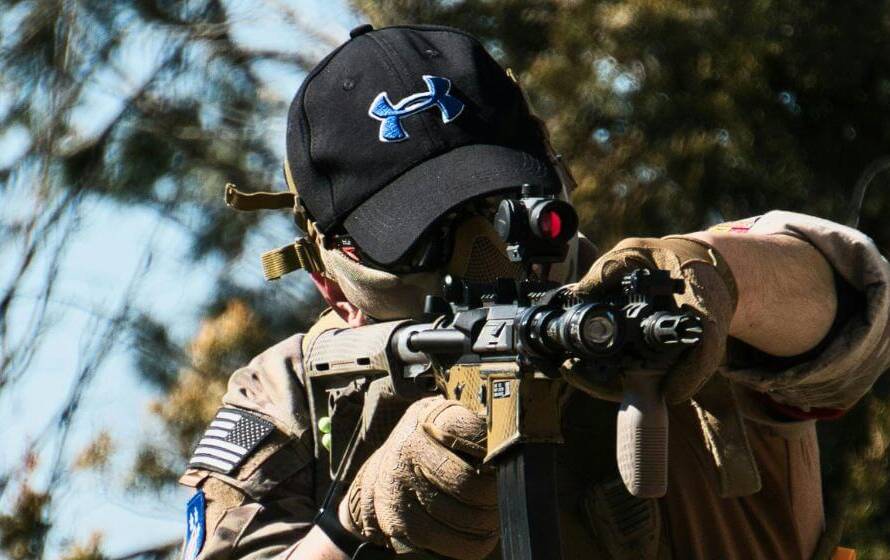
A semi-automatic rifle used for high-risk situations, including Immediate Action Rapid Deployment (IARD) scenarios for active threats. Depot’s firearms training has shifted emphasis toward the patrol carbine in recent years, moving away from the historical .22 calibre Lee-Enfield C No. 7 rifle used in older cadet programs.
The TASER 7
Cadets also train with the TASER 7 conducted energy weapon, which replaced the older TASER X26 in RCMP training as of October 2022/April 2024. The TASER 7 is classified as a use-of-force option under the Incident Management Intervention Model (IMIM) and is covered in the Police Defensive Tactics block alongside physical techniques.
The firearms training facilities at Depot
Depot has a purpose-built Firearms Complex featuring:
- Two 25-metre indoor ranges
- One 100-metre indoor range
- Firearms Training Simulators (FATS) — judgment-based scenario screens
The simulators allow cadets to work through high-stress decision-making scenarios before going live on the range. They replicate situations where the right answer may not be to fire — teaching restraint alongside accuracy.
A 2012 RCMP Gazette report noted that two full troops completed the RCMP’s entire course of fire virtually using simulators, and all passed final qualification. Skills transferred well into real-world shooting, though live training remained essential for recoil management, magazine changes, and the psychological weight of handling live weapons.
What 80% of cadets don’t know before arriving
According to RCMP Depot data, 80 percent of cadets have never fired a firearm before starting the Cadet Training Program. The program is designed to accommodate complete beginners. It builds from safe handling fundamentals through to operational proficiency and judgment under stress.
The Incident Management Intervention Model — the legal and ethical framework governing all force decisions — runs through every aspect of firearms training. Cadets must be able to justify any use of force under Section 25 of the Criminal Code, which requires that force be reasonable, necessary, and proportional.
Firearms training and the law
RCMP Depot firearms training is inseparable from legal training. Cadets cannot simply learn to shoot — they must know when shooting is lawful, when it is not, and how to articulate their decision afterward. All of this is assessed in both written exams and scenario-based evaluations.
For the full picture of what cadets learn across all seven training blocks, including Firearms, see the full Depot curriculum breakdown. For the fitness requirements cadets must also meet, see the RCMP fitness standards page.
Cadets train with the Smith and Wesson 9mm pistol, 12-gauge pump-action shotgun, and patrol carbine during RCMP Depot firearms training, plus the TASER 7 in the Police Defensive Tactics block.
Firearms training accounts for 104 of the 820 total hours in the Cadet Training Program — the second-largest block after Applied Police Sciences at 432 hours.
No. About 80 percent of cadets have never fired a gun before arriving at Depot. The program starts from safe handling fundamentals and builds to full operational proficiency.
Yes. The TASER 7, which replaced the TASER X26 in 2022–2024, is part of Police Defensive Tactics training alongside physical control techniques.
Sources:
Cadet Training Program | Royal Canadian Mounted Police
About Depot Division | Royal Canadian Mounted Police
This article reflects current RCMP policy based on official government documentation. Eligibility and suitability decisions are assessed on a case-by-case basis during the application process.