


PAL License Canada 2026: Requirements, Application Steps & Costs
Quick Answer: A PAL (Possession and Acquisition Licence) is Canada’s federal firearms licence for possessing and acquiring firearms. You need CFSC training, an RCMP application, background screening, and a mandatory 28-day waiting period after approval.
For the full PAL walkthrough, see our Canada firearms licence guide.
PAL timelines usually stretch when CFSC proof, references, or CFO follow-up are incomplete — not because of the 28-day waiting period alone. Submit a complete application and answer CFO requests promptly.
What Does PAL Stand For and Why Do You Need One?
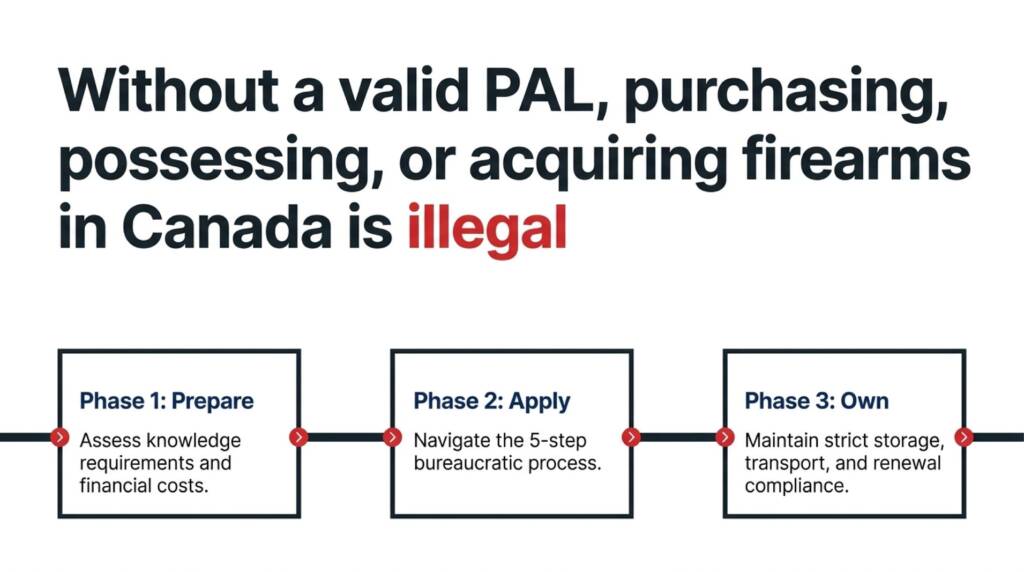
PAL stands for Possession and Acquisition License. In Canada, federal law requires anyone who wants to own firearms to obtain this license first. The PAL license system was established under the Firearms Act to enhance public safety while allowing responsible individuals to legally own guns for hunting, sport shooting, and collecting purposes.
Without a valid PAL license, purchasing, possessing, or acquiring firearms in Canada is illegal. This applies to both non-restricted firearms (like most rifles and shotguns) and restricted firearms (such as handguns and certain semi-automatic rifles).
Types of PAL Licenses Available
Quick Answer:Canada offers two main types of PAL licenses, each with different privileges and requirements. Understanding these differences is important for determining which license suits your needs.
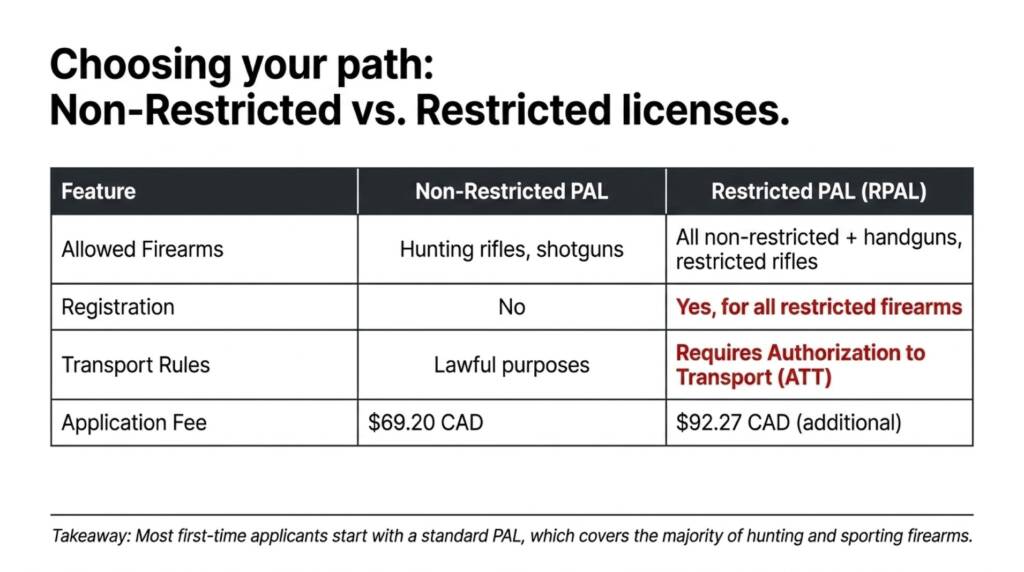
| License Type | Firearms Allowed | Registration Required | Transportation Rules | Application Fee |
|---|---|---|---|---|
| Non-Restricted PAL | Hunting rifles, shotguns, some semi-automatics | No | Can transport for lawful purposes | $69.20 CAD |
| Restricted PAL (RPAL) | All non-restricted + handguns, restricted rifles | Yes, all restricted firearms | Requires Authorization to Transport (ATT) | $92.27 CAD (additional) |
Non-Restricted PAL License
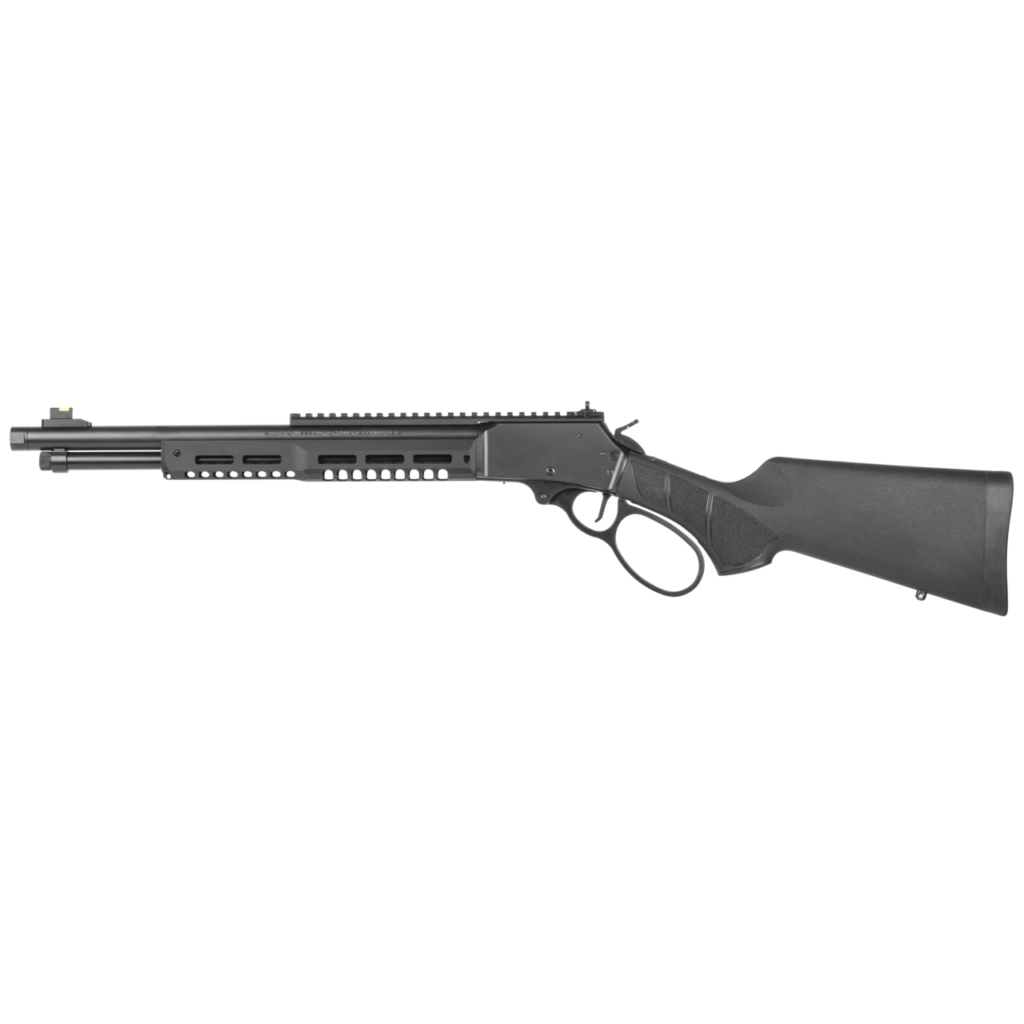
The non-restricted PAL license allows you to purchase and possess non-restricted firearms. These typically include hunting rifles, shotguns, and some semi-automatic firearms that meet specific criteria. Most first-time applicants start with this license type because it covers the majority of hunting and sporting firearms.
Restricted PAL License (RPAL)
The Restricted PAL license, commonly called RPAL, permits ownership of both non-restricted and restricted firearms. Restricted firearms include handguns, certain semi-automatic rifles, and firearms with barrels shorter than specified lengths. Additionally, RPAL holders must register their restricted firearms and can only transport them to approved locations.
Firearm Categories by License Type
Quick Answer:Understanding which firearms fall under each category helps you choose the appropriate PAL license for your intended use.
Non-Restricted Firearms (Regular PAL):
- Bolt-action rifles
- Semi-automatic rifles (meeting barrel length requirements)
- Shotguns (meeting barrel length requirements)
- Manual-action rifles
- Some antique firearms
Restricted Firearms (RPAL Required):
- Handguns (all types)
- Semi-automatic rifles with barrels less than 470mm
- Rifles that can be reduced to less than 660mm overall length
- Firearms prescribed as restricted by regulation
Prohibited Firearms (Special Authorization):
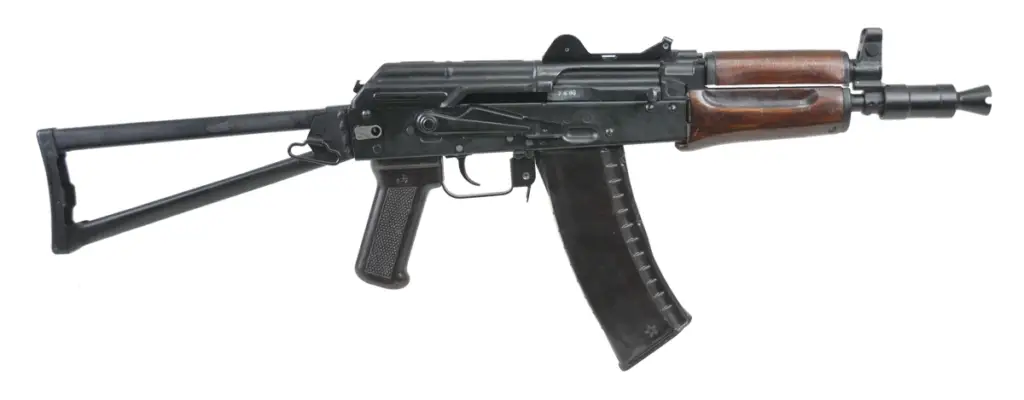
- Fully automatic weapons
- Converted automatics
- Handguns with barrels 105mm or less
- .25 and .32 caliber handguns
How Do You Apply for a PAL License?
Quick Answer:Obtaining a PAL license involves several mandatory steps that make sure applicants meet safety and legal requirements. The process is standardized across Canada but requires careful attention to detail.
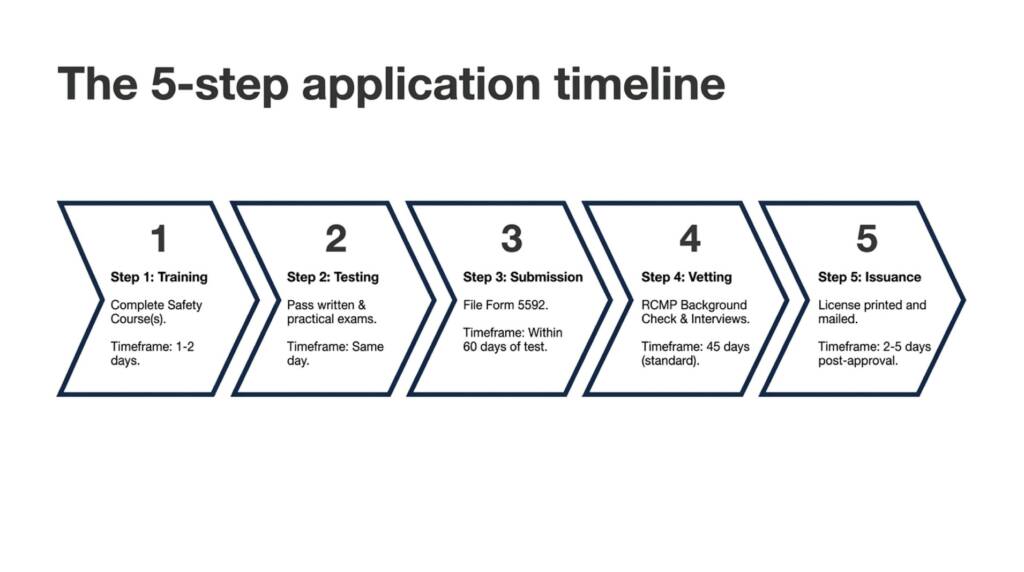
| Stage | Timeframe | Requirements |
|---|---|---|
| Safety Course Completion | 1-2 days | CFSC (and CRFSC for restricted) |
| Written & Practical Tests | Same day as course | Must achieve 80% or higher |
| Application Submission | Within 60 days of test | Complete forms, photos, references |
| RCMP Processing | 45 days (standard) | Background check, reference interviews |
| License Issuance | 2-5 days after approval | Mailed to registered address |
Step 1: Complete the Canadian Firearms Safety Course
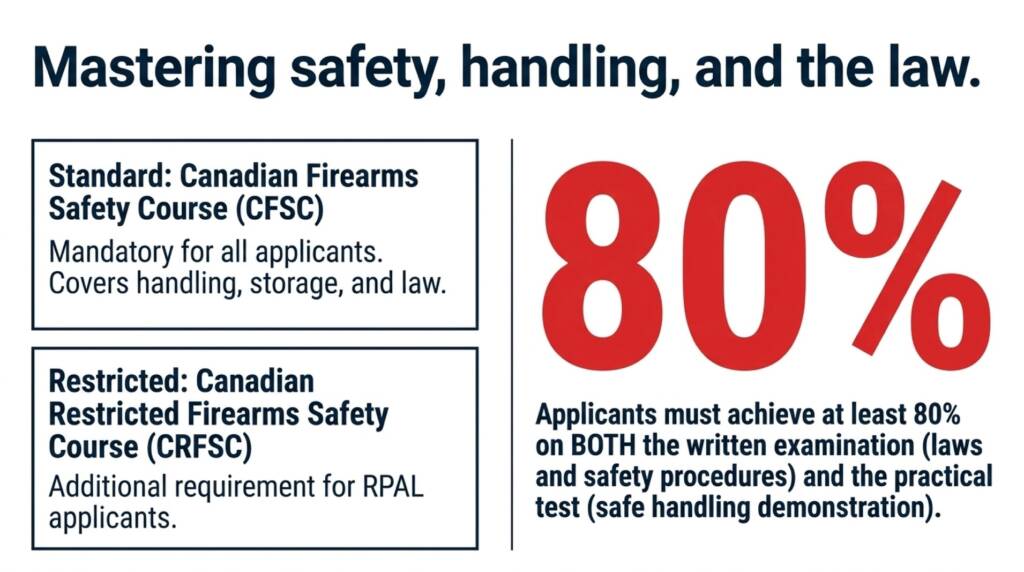
First, you must complete the Canadian Firearms Safety Course (CFSC). This course covers firearm safety, handling, storage, and relevant laws. For restricted firearms, you’ll also need the Canadian Restricted Firearms Safety Course (CRFSC). These courses are offered by certified instructors across Canada and typically take one to two days to complete.
Step 2: Pass the Written and Practical Tests
After completing the safety course, you must pass both written and practical examinations. The written test covers firearm laws, safety procedures, and proper handling techniques. Meanwhile, the practical test demonstrates your ability to safely handle different types of firearms. You need to achieve at least 80% on both components to pass.
Step 3: Submit Your Application
Complete the PAL license application form (RCMP Form 5592) with required documentation. This detailed application requires careful attention to detail and complete information.
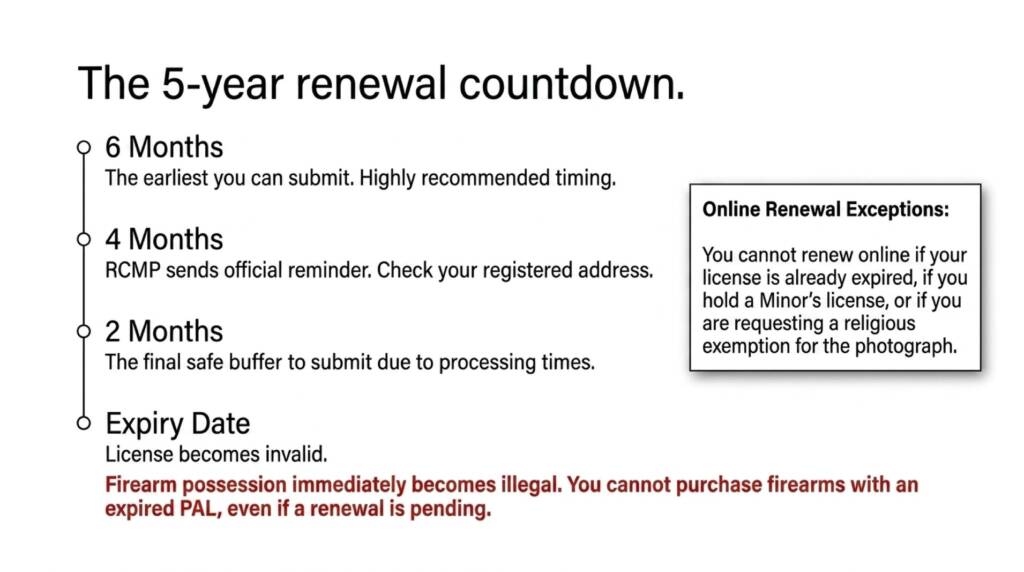
Required Documentation Checklist
For Initial PAL License Application:
- [ ] Completed RCMP Form 5592
- [ ] Proof of safety course completion
- [ ] Test results (written and practical)
- [ ] Two recent passport-style photographs
- [ ] Two reference contacts (known for 3+ years)
- [ ] Valid government-issued photo ID (copy)
- [ ] Application fee payment
- [ ] Medical documentation (if applicable)
- [ ] Court records (if applicable)
Step 4: Background Check and Waiting Period
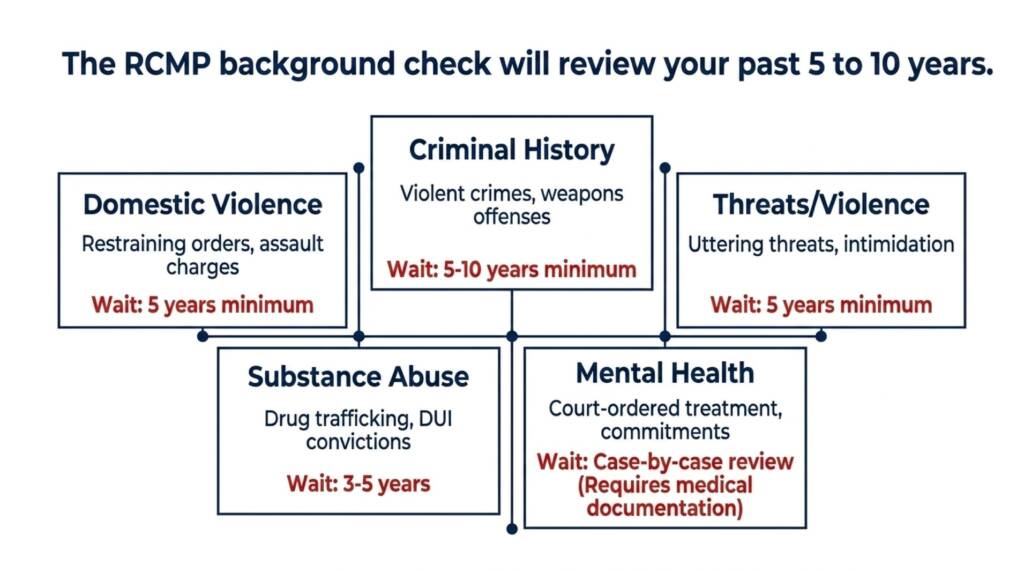
The RCMP conducts a comprehensive background check, including criminal history, mental health records, and personal references. Processing typically takes 45 days for first-time applications, though complex cases may require additional time. During this period, the RCMP may contact your references for detailed interviews.
PAL License Requirements and Eligibility
Several requirements must be met before obtaining a PAL license in Canada. Understanding these criteria helps applicants prepare appropriately and avoid common rejection reasons.
Age Requirements
Applicants must be at least 18 years old for a standard PAL license. However, minors aged 12-17 can apply for a minor’s license with parental consent and additional restrictions. Minor licenses have specific limitations on firearm types and supervision requirements.
Background Check Criteria
The RCMP evaluates various factors during the background check process. These include criminal history, domestic violence incidents, mental health issues, and substance abuse problems. Any history of violence or threats may disqualify an applicant, depending on the severity and time elapsed.
| Category | Disqualifying Conditions | Waiting Period |
|---|---|---|
| Criminal History | Violent crimes, weapons offenses | 5-10 years minimum |
| Mental Health | Court-ordered treatment, commitments | Case-by-case review |
| Domestic Violence | Restraining orders, assault charges | 5 years minimum |
| Substance Abuse | Drug trafficking, DUI convictions | 3-5 years |
| Threats/Violence | Uttering threats, intimidation | 5 years minimum |
Ongoing Responsibilities
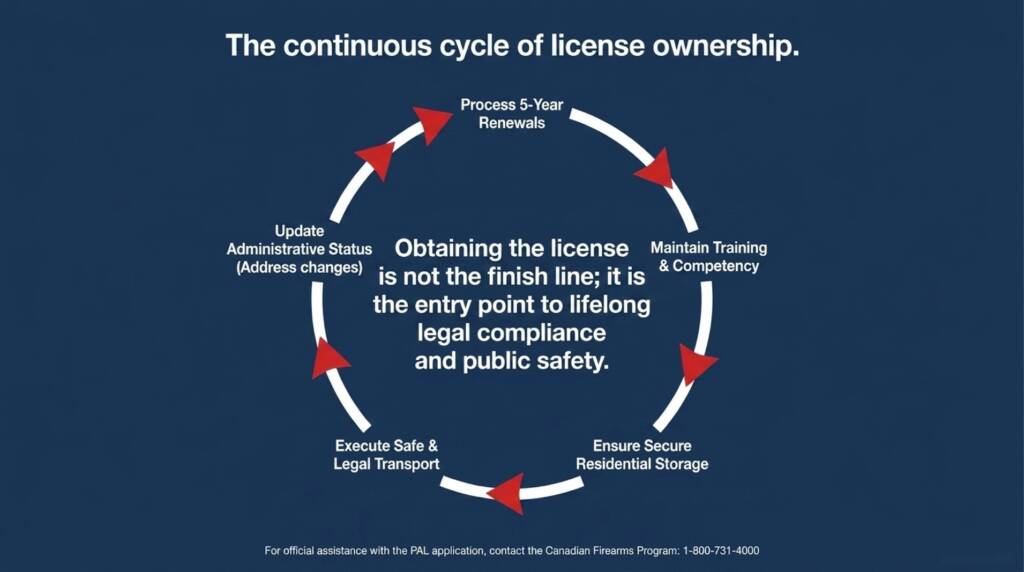
PAL license holders must notify the RCMP of address changes within 30 days, report lost or stolen firearms immediately, and comply with storage regulations. Also, licenses must be renewed every five years, requiring updated background checks and documentation.
How Much Does a PAL License Cost?
Understanding PAL license costs helps applicants budget appropriately for the process. Costs vary by region and instructor, but the following table provides typical ranges.
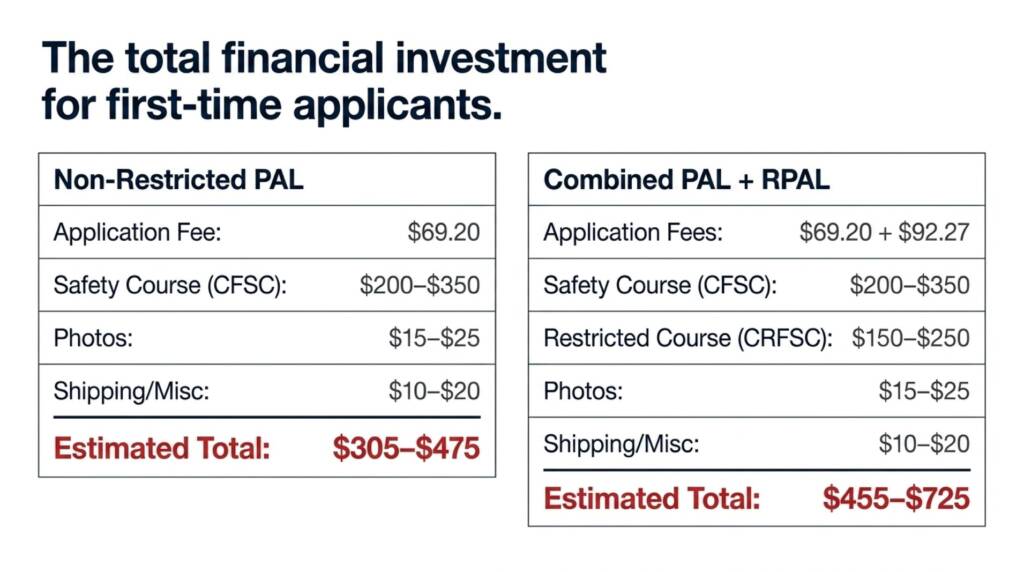
| Item | Non-Restricted | Restricted | Combined |
|---|---|---|---|
| Application Fee | $69.20 | $92.27 | $– |
| Safety Course (CFSC) | $200-350 | – | $200-350 |
| Restricted Course (CRFSC) | – | $150-250 | $150-250 |
| Photos | $15-25 | $15-25 | $15-25 |
| Shipping/Misc | $10-20 | $10-20 | $10-20 |
| Total Estimated Cost | $305-475 | $255-375 | $455-725 |
The basic application fees include $69.20 for a non-restricted PAL license and $92.27 for a restricted license (you can apply for both simultaneously). Additionally, course fees typically range from $200-400 depending on your location and instructor.
Other potential costs include passport photos ($15-25), shipping fees for applications, and renewal fees every five years. Overall, first-time applicants should budget approximately $400-500 for the complete process, while those seeking both licenses should expect costs of $600-700.
Common PAL License Application Mistakes to Avoid
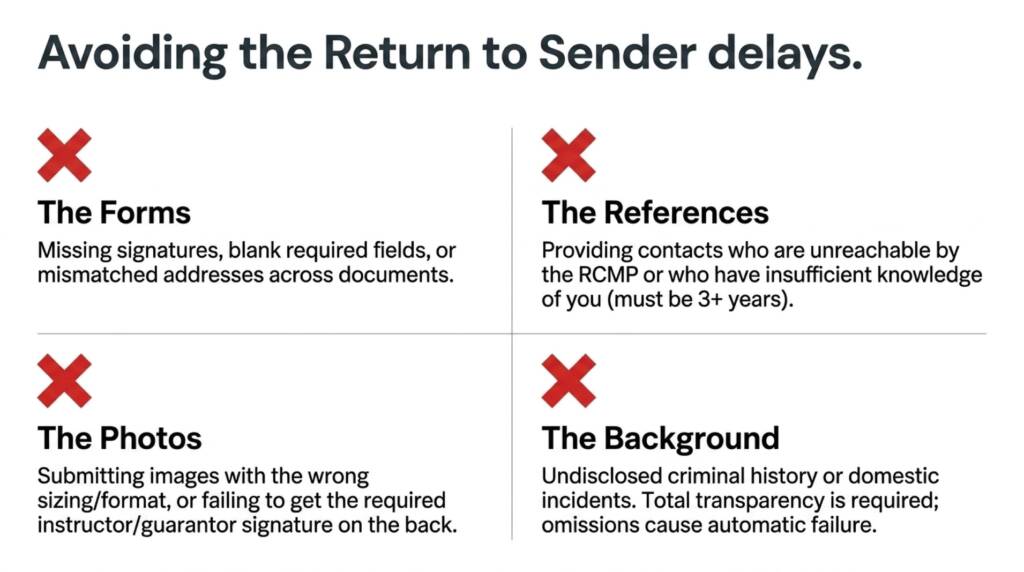
Many applicants encounter delays due to preventable errors in their applications. Understanding these common pitfalls helps make sure processing goes smoothly.
Common Application Rejection Reasons:
- Incomplete Forms
- Missing signatures or dates
- Blank required fields
- Incorrect information
- Reference Issues
- References unavailable for interviews
- Insufficient knowledge of applicant
- Incomplete contact information
- Photo Problems
- Wrong size or format
- Poor quality images
- Missing instructor signature
- Background Check Failures
- Undisclosed criminal history
- Mental health concerns
- Domestic violence history
- Course/Test Issues
- Expired test results
- Failed examinations
- Invalid course completion
Incomplete reference information is a frequent issue. Your references must provide complete contact information and be available for RCMP interviews. Also, make sure all forms are signed and dated correctly, as missing signatures cause automatic rejections.
Photo requirements are strict and often overlooked. Photos must be recent, passport-style, and signed by your instructor or guarantor. Poor quality or incorrect photos result in application returns and delays.
Finally, address discrepancies between your application and supporting documents create problems. Make sure all addresses match exactly across all forms and identification documents.
PAL License Storage and Transportation Laws
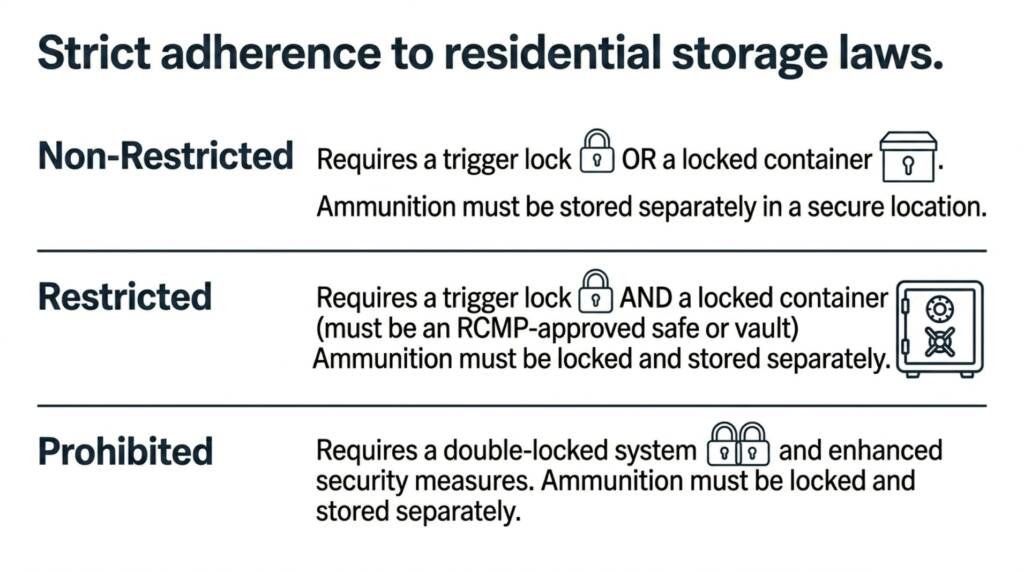
PAL license holders must comply with strict storage and transportation regulations outlined in the Firearms Act. These requirements vary by firearm type and are strictly enforced.
Storage Requirements by Firearm Type
| Firearm Type | Storage Method | Ammunition Storage | Additional Requirements |
|---|---|---|---|
| Non-Restricted | Trigger lock OR locked container | Stored separately | In secure location |
| Restricted | Trigger lock AND locked container | Locked, stored separately | RCMP-approved safe/vault |
| Prohibited | Double-locked system | Locked, stored separately | Enhanced security measures |
Transportation Rules

Non-restricted firearms can be transported for lawful purposes without additional permits. However, restricted firearms require Authorization to Transport (ATT) permits for most movements.
Transportation Authorization Requirements
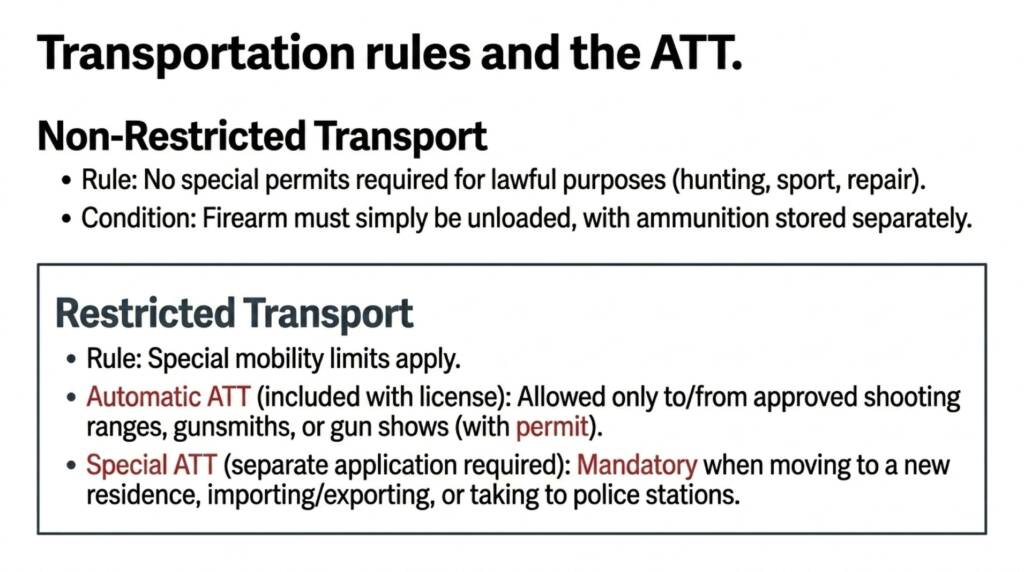
You can now apply for an Authorization to Transport (ATT) online.
Non-Restricted Firearms:
- No special permits required
- Must be unloaded during transport
- Ammunition stored separately
- Can transport for hunting, sport shooting, repair
Restricted Firearms:
- Automatic ATT (included with license):
- To/from approved shooting ranges
- To/from gun shows (with permit)
- To/from gunsmith for repair
- Special ATT Required for:
- Moving to new residence
- Importing/exporting
- Taking to police stations
- Any other transportation
PAL License Renewal Process
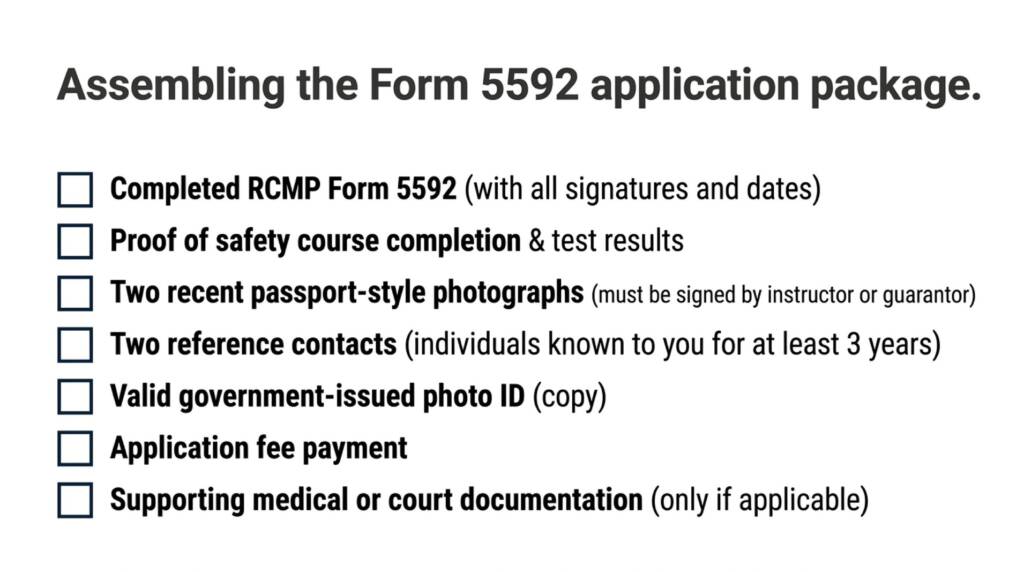
PAL licenses expire every five years and must be renewed to remain valid. The renewal process is generally simpler than initial applications but still requires attention to detail and proper timing, and the good news is you can do it online.
| Time Before Expiry | Action Required | Consequences |
|---|---|---|
| 6 months | Can submit renewal | Recommended timing |
| 4 months | RCMP sends reminder | Check address is current |
| 2 months | Should submit if not done | Processing time buffer |
| 1 month | Final opportunity | Risk of expiry |
| Expiry date | License invalid | Cannot possess firearms |
You CANNOT renew your firearms licence online if any of the following conditions apply to you
- You are requesting a religious exemption from providing a photograph with your licence
- You already have a licence renewal application in progress
- Your licence has expired or is otherwise no longer valid
- Your licence is a Minor’s licence
Renewal Documentation Required:
- [ ] Completed renewal form
- [ ] Two recent passport-style photographs
- [ ] Updated reference information
- [ ] Renewal fee payment
- [ ] Address change documentation (if moved)
Renewal applications can be submitted up to six months before expiration. The RCMP sends renewal notices approximately four months before your license expires. Renewal requires updated background checks, current photographs, and the $92.27 renewal fee.
Importantly, you cannot purchase firearms with an expired PAL license, even if your renewal application is pending. Therefore, submitting renewal applications early prevents gaps in your licensing status.
Provincial Variations and Additional Requirements
While PAL licenses are federally regulated, some provinces have additional requirements or variations in implementation.
| Province/Territory | Additional Requirements | Notes |
|---|---|---|
| Ontario | None beyond federal | Standard federal rules apply |
| Quebec | Provincial registration | Additional paperwork required |
| Alberta | None beyond federal | Hunting license may be required |
| British Columbia | None beyond federal | Some municipal restrictions |
| Manitoba | None beyond federal | Standard federal rules apply |
| All Others | None beyond federal | Check local municipal bylaws |
Most provinces follow standard federal requirements, but Quebec has additional provincial registration requirements for non-restricted firearms. Some municipalities may also have bylaws affecting firearm storage or transportation within city limits.
What Happens if Your PAL License Application is Denied?
If your PAL license application is denied, you have legal options for appeal. The RCMP provides written reasons for denial, which typically relate to background check issues or incomplete applications.
Appeals must be filed with the Federal Court of Canada within 30 days of receiving the denial notice. Successful appeals often address the specific concerns raised in the denial and provide additional supporting documentation or evidence of rehabilitation.
Common reasons for denial include undisclosed criminal history, mental health concerns, domestic violence incidents, or substance abuse issues. Working with legal counsel experienced in firearms law can improve your chances of a successful appeal.
Important Safety Considerations
Beyond legal requirements, PAL license holders have moral and ethical responsibilities for firearm safety. This includes proper storage, secure transportation, and making sure firearms never reach unauthorized individuals, especially children.
Regular training and practice improve safety and competency. Many shooting ranges offer advanced courses and regular practice opportunities. Staying current with safety practices and legal requirements demonstrates responsible ownership.
Consider joining recognized firearms organizations like the National Firearms Association or provincial hunting associations. These groups provide ongoing education, legal updates, and advocacy for responsible firearms owners.
Conclusion
Obtaining a PAL license is essential for anyone wanting to legally own firearms in Canada. While the process requires time, training, and patience, following proper procedures makes sure you stay compliant with federal firearms laws. Remember that responsible firearm ownership extends beyond obtaining your license to include ongoing compliance with storage, transportation, and renewal requirements.
The investment in proper training and legal compliance protects both individual rights and public safety. By understanding the requirements, costs, and ongoing responsibilities, prospective PAL license holders can work through the system successfully and enjoy lawful firearm ownership in Canada.
For complete application forms and current requirements, visit the Royal Canadian Mounted Police firearms licensing website. Stay informed about changes to firearms laws and regulations through official government sources and reputable firearms organizations.
Frequently Asked Questions
Processing typically takes 45 days for first-time applications after the RCMP receives your complete application. However, applications requiring additional review may take several months to process. Complex background checks or incomplete applications can significantly extend processing times.
Yes, applicants can appeal denied applications through the Federal Court of Canada. Appeals must be filed within 30 days of receiving the denial notice and should include supporting documentation addressing the denial reasons. Legal representation is recommended for appeals.
An expired PAL license makes firearm possession illegal. You must immediately secure your firearms appropriately and cannot purchase additional firearms until your license is renewed. Contact the RCMP immediately if your license expires and secure all firearms according to storage regulations.
PAL licenses are valid across all Canadian provinces and territories. However, some provinces have additional regulations or restrictions that may apply to non-residents. Always check local laws when traveling with firearms to other provinces.
No separate license is required for ammunition purchases. However, you must present a valid PAL license when purchasing ammunition, and retailers verify your license status before completing sales. Ammunition purchases are recorded and may be subject to quantity restrictions.
You can only lend firearms to individuals who hold appropriate PAL licenses. The borrower must possess the correct license type for the firearm category. Lending firearms to unlicensed individuals is illegal and can result in criminal charges.
PAL license holders must notify the RCMP of address changes within 30 days. Failure to report address changes can result in license suspension or revocation. Update your address through the RCMP website or by calling their firearms program.
need help completing PAL license application please call 1-800-731-4000
References
- Royal Canadian Mounted Police. “Canadian Firearms Program – Safety Courses.” rcmp.ca/en/firearms
- Department of Justice Canada. “Storage, Display, Transportation and Handling of Firearms Regulations (SOR/98-209).” laws-lois.justice.gc.ca
- RCMP Headquarters. “Canadian Firearms Safety Course – Official Training Manual.” publications.gc.ca
- BC Firearms Academy. “PAL and RPAL Costs in Canada (2025).” bcfirearmsacademy.ca
- Silver Willow Firearms Law. “Recent Changes to Canadian Firearms Laws [Updated 2024].” silverwillow.ca
- RCMP. “Authorization to Transport – Canadian Firearms Program.” rcmp.ca/en/firearms
- Silvercore Firearms Training. “Canadian Firearms Safety Course Requirements.” silvercore.ca
This article reflects current Canadian firearms law and RCMP Canadian Firearms Program guidance based on official government sources. Licensing and authorization decisions are assessed on a case-by-case basis by the Chief Firearms Officer or the RCMP.
Disclaimer: This article is for general guidance only. Firearms rules, prohibited models, and program requirements change. Confirm current requirements with the RCMP Canadian Firearms Program or your provincial Chief Firearms Officer before applying or transferring firearms.


2 Comments
Andrew Mulder
Hello there, I recently appplied for my PAL and provided my VISA number but unfortunately the card has gone missing and I had to block the card. Apparently, the RCMP had tried to charge the card 3 times for my PAL application fee but unfortunately, it wasn’t working. I have a new card now. How do I reach the proper department in order to provide the current card information?
Thank you kindly,
Andrew R. Mulder
The joinRCMP.ca Team
Hi Andrew,
Thanks for reaching out. You have two options to update your payment information:
Option 1:
Visit the official RCMP firearms portal at https://firearms-armes-a-feu.rcmp-grc.ca/en
.
Once logged in, go to Home → Inbox, then send a message requesting to update your payment information.
👉 Important: Don’t send your credit card details right away. Instead, ask if it’s safe to share your personal information through the platform. An agent will usually reply within 48 hours to confirm the next steps.
Option 2:
Call the Canadian Firearms Program at 1-800-731-4000 and select option 5 for general inquiries.
Let the agent know you want to update your payment information. They’ll verify your personal details (name, email, date of birth, and phone number), then guide you through securely providing your new card details.
Hopefully this helps!
Thank you very much, and best of luck with your PAL application.
— The joinRCMP.ca Team